

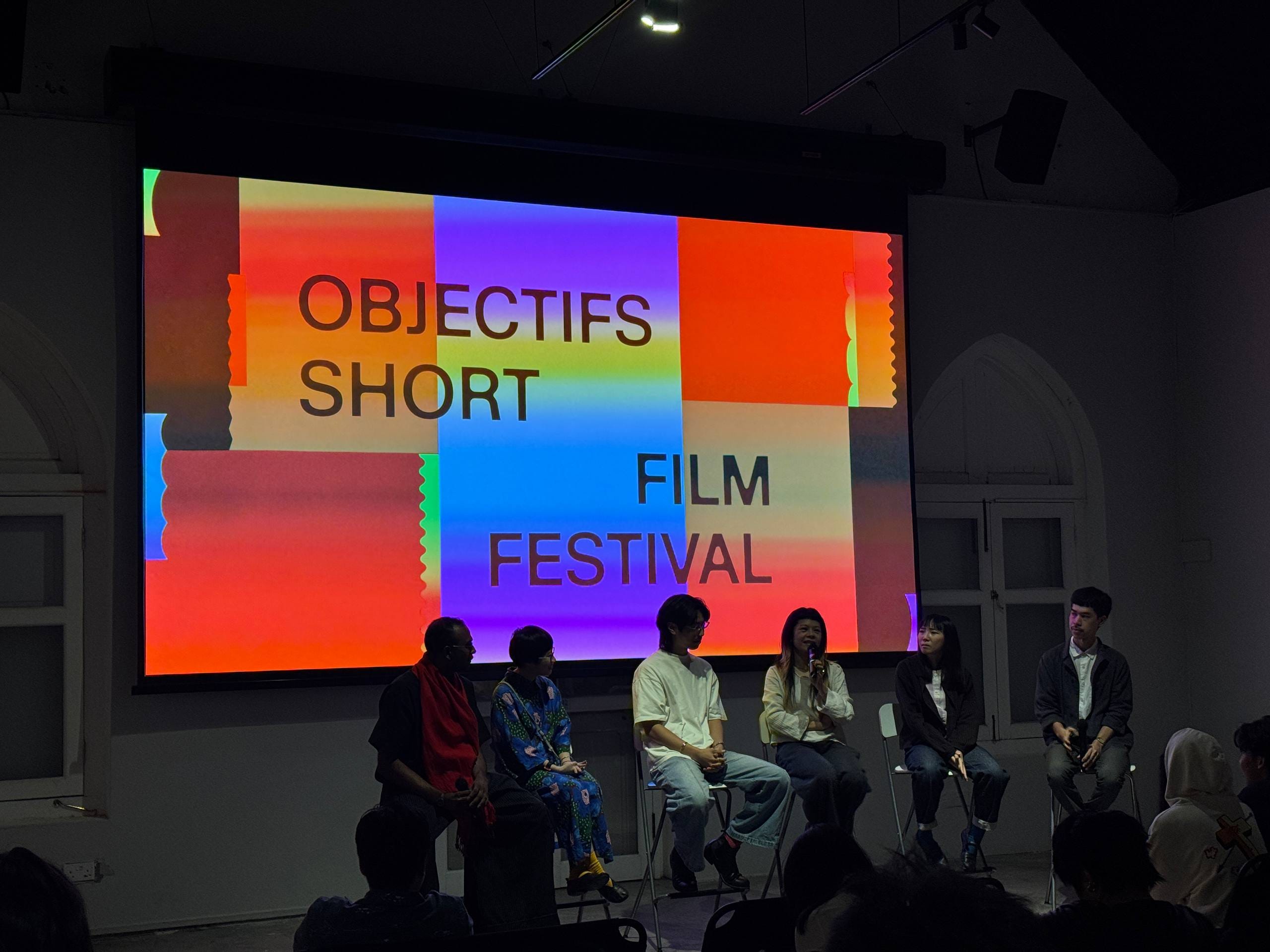
One of Objectifs’ hallmark events is the annual FreshTake! that spotlights short films by first-time or early-stage filmmakers. What is celebrated here is not your usual high-brow artistic achievements, but the courageous attempt to do something different and new. Just as short films are pockets of adventures into new worlds and perspectives, FreshTake! discovers refreshing ones within Singapore. This year, the programme was co-curated by EXYL, a filmmaker and programmer in experimental arts.
The programme opens with LASALLE BA (Hons) thesis film Bahay-Bahayan by Filipino filmmaker Marienne Louise. In it, mid-twenties Joanna has to reconcile with her past of growing up disconnected from her mother working abroad. The film speaks to the larger Overseas Filipino Workers (OFW) experience. Shot intricately on analogue, the spellbinding truthfulness concocted by its confessional voiceover and dreamlike visuals of the Philippines invites you into both the everyday lives of a mundane Filipino and the pains of growing up distant from your mother.
This was followed by Clemens Choy’s Where the Heart Sings from Nanyang Technological University (NTU)’s Wee Kim Wee School of Communications and Information. It explores the role of music in Burmese resistance both during the 1988 coup and the 2021 developments. The film was largely shot in conversation with the Burmese diaspora in Mae Sot, Thailand. The film’s generations of artist-activists like Mun Awng from before and now Thoo Lei (CHOXEN) build a sense of longevity in efforts of resistance. Nonetheless, the film can feel superficial, resembling a television documentary that offers snapshots of an important community and its experiences, without delving deeper into its genesis, history, or the circumstances that have shaped it. There was no exploration of the music and craft. Speaking after the screening, Choy’s engagement with the community also seems superficial: During production, he did not understand the use of the three-finger salute in Myanmar and had to ask his subjects about its symbolism as an act of resistance. Yet, the film makes no apparent connection to how the people of Myanmar adopted the gesture from The Hunger Games as a symbol. Whilst this is extraneous to the film itself, the omission underscores a broader lack of curiosity and depth in its exploration of an important topic and the perspectives it seeks to represent.
Kamikaze Lizard by LASALLE student Joel Lim is perhaps one of the most exciting and breathtaking short films yet. Juliet is killed by a Kamikaze Lizard. Reborn, she helps save a young man from that same Lizard. Combining aesthetics and effects from anime and B-movies, the film is a thrilling work that evokes much laughter and surprise. Sudden flashbangs of lights and transitions between darkness and light, trashy (literally) production design, and cheap evocations of gore all create the coming of a cult classic. It is no surprise that when the credits roll, one audience member continued slow clapping at its apparent brilliance. That said, the film is weakest when it engages with moments of realism where naturalistic dialogue contrasts drastically with the film’s more adventurous tone.
Saksham Mehrotra’s seaward has made an impact across its many screenings in Singapore, particularly at environmental and documentary festivals. And deservedly so. It responds to Prime Minister Lawrence Wong’s remarks that land growth in Singapore either expands upwards, downwards or seaward––a reference to the continued land reclamation efforts of the island-city. Wong’s announcement at this year’s National Day Rally for more reclamation plans of the Southern Islands drew significant backlash. Mehrotra, however, does not make an angry documentary presenting a case against coastal redevelopment. Instead, he simply takes eight minutes to spend time with the marine creatures found on our shores. These intricate images and crisp sound design by Felix Galistan are contrasted with images of cranes and construction in Singapore. Fundamentally, the film invites us to consider the cost of our policy. Yet, this act of looking also turns the experience of time radical: in forcing an audience to spend time with the creatures, the filmmakers emphasise the nation’s rapid and ravenous progress. Against trade-offs, spending time and paying attention to the small and vulnerable is an act of radicalism.
The programme continued with LASALLE student Claudia Michelle’s Lintasan. Set at the Raffles Marina lighthouse near the Tuas Causeway linking Malaysia and Singapore, a Singaporean woman has to revisit her nationhood when her Malaysian boyfriend proposes to her. The film’s cinematography is remarkable. Shot mostly on wide lenses, landscape and profiles come into simultaneous focus, perhaps helpful for the film’s references to nationhood. One memorable scene was the woman facing out the window whilst the man sits on the hotel bed looking down. It features considered blocking, elevated by soft lighting and an extended duration that emphasises the psychological subtext, à la European arthouse cinema. However, while the cinematography and storytelling premise are outstanding, the film is extremely hampered by the performance of its leads. Whilst they might not be bad actors, their lack of chemistry in this film does not make the histories of their relationships palpable. These provide no stake or tension to the proposal at hand, therefore rendering the film ineffective.
FreshTake! Concluded with Valerie Theodas’s Last Supper, which was completed at NTU School of Art, Design and Media (ADM) as a module submission. A scientist obsessed with moths accidentally ingests a mould that leads into a surrealistic journey to purify himself. With psychedelic visuals, high contrast, and extreme saturation, Theodas proves to be a force of nature and a filmmaker to watch. The creativity never compromises its moments of brevity and inventiveness, such as humorously using laundry detergent as a mode of purification or associating that plot with a laundry cycle. Unfortunately, contradicting the artistic inventiveness of the film, the leads’ performances did not belong in the film, particularly in grounding the film’s realistic premise prior to its phantasmagoric experimentation. Small moments of waking up and miming concern are neither convincing nor effective. The director later shared that she had limited time with both actors as they were committed elsewhere, making this shortcoming understandable.
Spirited and revelatory, these shorts hint at the concerns of a younger batch of filmmakers. Where there are true standouts and fresh perspectives, the outstanding shorts are radical, experimental, and visionary in both ideology and craft. Whilst one programme cannot speak for an entire generation, the breadth of themes here should bode well for a generation still curious and in love with filmmaking.
Written by Daryl Cheong, edited by Phyllis Chan