


The first time I watched Andrei Tarkovsky’s Stalker (1979), I was in the middle of my National Service. In spite of the low-resolution Internet copy I found, it easily became one of my favourite films.
Close to a decade has passed.
Rewatching the film on Filmhouse’s big screen, my sentiments have not changed. But my experience has.
There is no need to rehash another review of Stalker. For the unacquainted, the film follows the titular Stalker who leads a Writer and Professor into the mysterious Zone, where a mythical Room supposedly grants its visitors their deepest wishes. Rather than take a straight path towards it, however, they must respect the Zone and navigate its treacherous, inexplicable terrain.
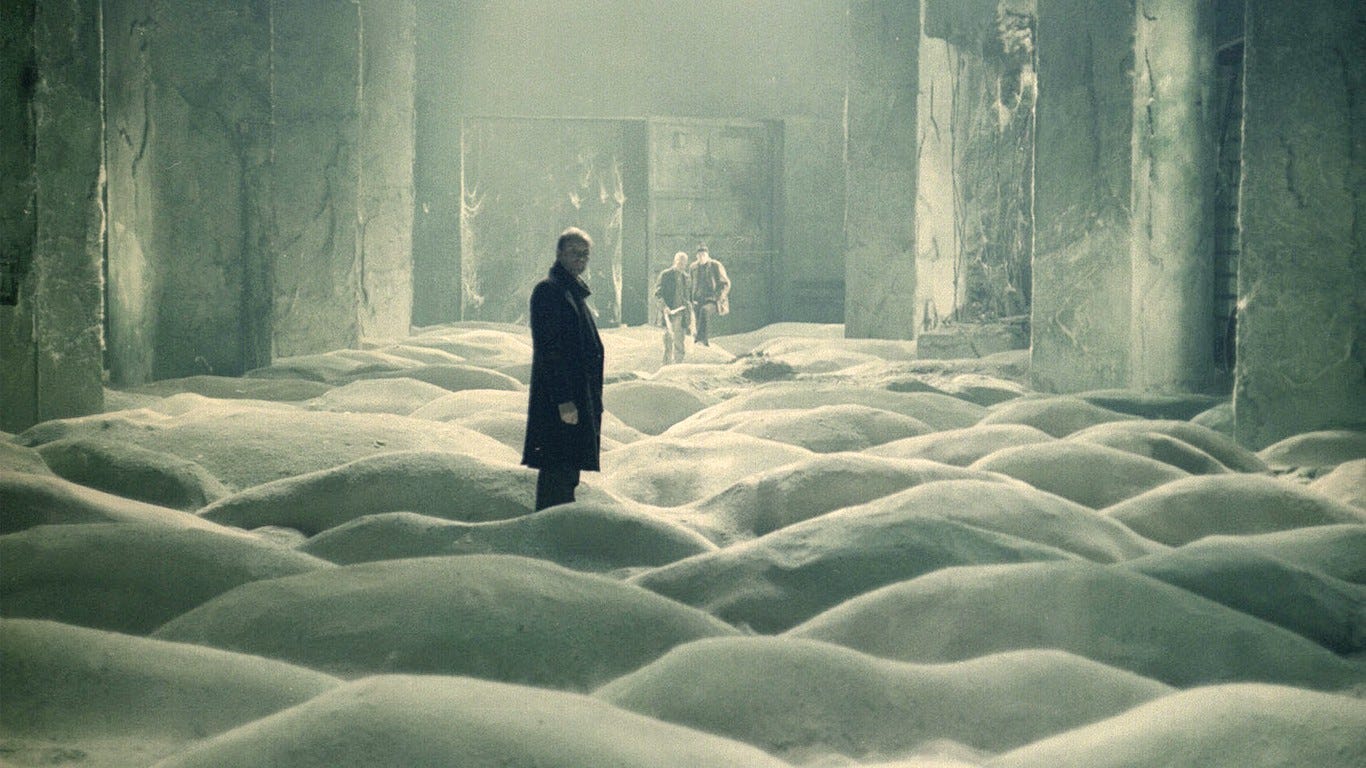
What ensues is a film about desire, faith and meaning: how our declared wishes may differ from our subconscious desires; how devotion to the mystical Zone parallels religious experience; and how meaning might be found by believing in hope and purpose within an increasingly broken world. For a first-time viewer, Stalker promises a spiritual exercise that, with patience, permits transcendence.
But watching it theatrically offered not simply a greater appreciation of these ideas, but an experience that embodies them.
Stalker proposes that we surrender to what we cannot understand. The theatre facilitates this surrender. Before the enormity of the screen, our minute presence gives itself over to the experience. Even when explanations remain elusive, sitting with discomfort and uncertainty becomes transformative in itself. Our doubts, questions and curiosities are not obstacles to the film’s potential transcendence, but necessary conditions for it.
Early in the film, a tracking shot introduces the Stalker, his wife and child. From the convenience of a laptop, I remembered it merely as exposition for the characters. On the big screen, its duration becomes an experience of discovery. Crossing the threshold into the bedroom shifts us from the social towards the familial and intimate; tracking back and forth across the bed continually reconsiders who is looking, what is being seen, and therefore what we thought we had understood. The essence of Stalker lies not only in its central concerns, but in experiencing a form that primes us for spiritual ascendancy.
For Tarkovsky, surrender becomes a spiritual necessity. Belief, and then faith, require precisely what cannot first be proven or understood. Stalker demands the same submission from its audience: transcendence becomes possible only when our desire for certainty is relinquished. It recalls Kierkegaard’s conception of faith becoming meaningful precisely where objective certainty fails. To demand that the Zone explain itself would therefore be to deny its possibility.
Perhaps that is why Stalker invites revisiting on the big screen. The Zone may remain unchanged, but we do not. A decade later, I entered the same film carrying different desires, doubts and experiences. Its mysteries had not been resolved. Instead, like those of the Zone, the film and life itself, these mysteries are renewed experiences that have shifted with me.
Written by Daryl Cheong, edited by Phyllis Chan.

