


Much has already been written in recent days about the premiere of the AI feature film Trace Project to coincide with Singapore’s National Day. Social media response has already reflected distrust towards the process of AI filmmaking. Instead, we felt obliged to cover it as we would for any other film premiering in theatres. What this writer discovered, after $20 and one hour he cannot recover, was that this film certainly has its audiences: smooth-brained and slacked-jaw.
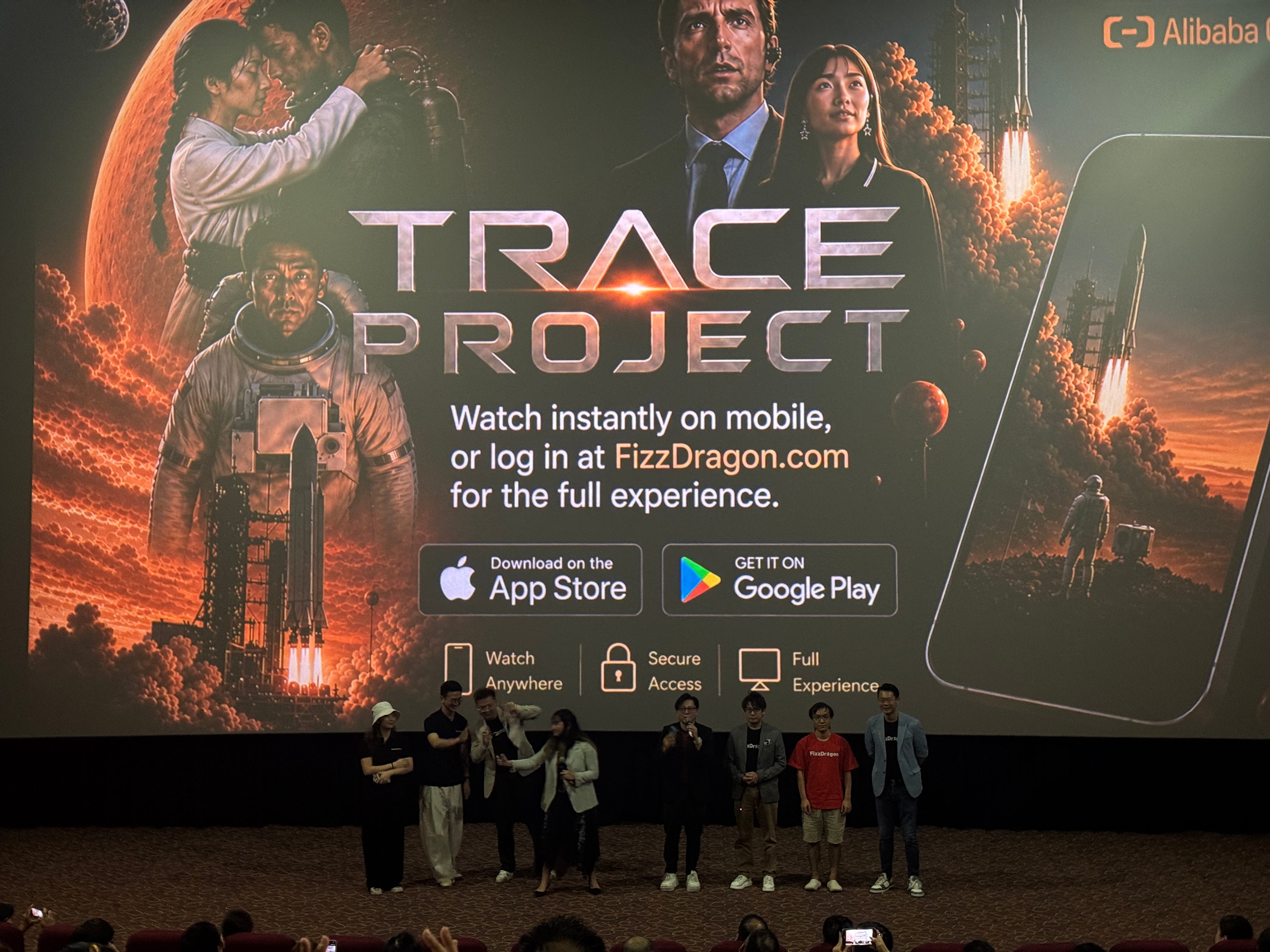
The ‘film’ is a Frankenstein’s monster of Dune and other science-fiction epics stripped of the humanity and heart of these stories. Due to climate change, much of the world has submerged and now turns to Mars as a solution. Each nation then sends some of its best candidates on space missions. Singapore, miraculously, decides to send Lin Jia Jun, the son of a cleaner. The plot tries to argue that though he does not have the best background or abilities, his heritage means that he is a “wild grass”—someone that cannot be burnt by fire, a weak metaphor for the trials of the mission.
After this premise of five minutes, the film takes strange and wild directions. We enter Black Mirror to see Lin form an ‘anchor point’ with childhood friend Chen Hui Min, whose convenient appearance sees her volunteering for ambitions of being an astronaut just to help ground him on Earth with a loosely explained connection. Next, we enter Guardians of the Galaxy to find a secret three-century-old colony living beneath Mars from (surprise!) Singapore. We traverse to I.S.S. as nations turn on one another, and secretly take its agents out. We then travel to Squid Game to find an elite class of Earthlings betting on which astronaut would die and succeed.
The film’s loose and unconnected threads speak to the nature of artificial intelligence. Plot points are lost within five minutes, the antagonist changes every scene, and entire characterisations change up between scenes.
The sound mix (or lack thereof) points to the disparate nature of the work. One scene ends, and the score abruptly cuts. Any attempts at drawing an emotional connection are lost immediately in a work paced like micro-dramas instead of a feature work. My ability to control the speed and experience of a micro-drama would be more pleasurable to this. There are moments where the story genuinely had something going for it, such as a gripping Dune-like score whilst crossing Mars and the entrance into the secret civilisation. Yet, the lack of creative supervision allowed for AI to hallucinate a film that bred incoherence and senselessness.
Central to dramatic works is conflict and obstacles. The production company somehow believes that conflict derives from externalised plot points that re-shape the work every five minutes. In key moments where something human could be derived, we move away. During Jun Jie’s onerous training to prove himself worthy, a human storyteller could have induced a Rocky-esque montage to honour his hard work and sacrifice. Instead, within five seconds, his difficulties are overcome no matter the set-up. The ‘storytelling’ here could only be sensible to a smooth-brained audience.
Consider, too, its problematic depictions of women. Hui Min, whose likeness was based on the production company FizzDragon founder Pax Chen, exists simply to serve Jun Jie. She exists to sacrifice her efforts for his dreams. Mind you, the characters are not married; She made the sacrifice purely because she once protected him from bullies as children, a trope common in Chinese micro-dramas. Within the Martian civilisation, Pai is an Angelina Jolie-like archetype who is brilliant, strong, and wise. Yet, we see her being commanded by Jun Jie, who has little to no experience on the planet. Women, like these AI tools, are abused in the service of a patriarchal vision of humanity.
Perhaps most telling is its depictions of ‘Singapore’. We speak with an accent that would locate us in the Western hemisphere. Between scenes, our national flag transforms from five white stars and a crescent moon into the five yellow stars of China’s flag. The film absurdly dramatises the migration of Southern Chinese sojourners to Singapore by proposing that the same Hakka migrants had the technology to travel to Mars three centuries ago as part of a secret plan that, in the film, is forgotten within ten minutes of its introduction.
Perhaps most fantastical was the occurrence of protests in Singapore that went unpunished, led by Pax Chen’s avatar Hui Min. The only non-Chinese character is an unnamed Indian man training Jun Jie at the beginning. Most racially problematic is that key texts in the film are written in Mandarin and untranslated into English, for a work whose subtitles and English writings are the consequence of AI-hallucinated spelling. Who knew humans depend on oxiygen!
I was surprised to find out that substance abuse in Singapore is illegal, when considering the many hallucinatory and fabricated narratives of the past hour.
In justifying the use of AI following the screening, founder Pax Chen defended that “to build a slower car is better than to stay in the era of horses.” It was a strange hallucinatory response about AI’s quality to a question about AI’s ethics. Nonetheless, taking it at face value, it is surprising that such terrible AI storytelling is used to justify the future of storytelling when its lack of rudimentary knowledge in filmmaking is comparable to a child’s. Adding further insult to injury, Chen argues “the only way we see for local content to be created is with AI Generative Content” as if a whole industry of filmmaking does not exist within Singapore.
Chen emphasises that the film exists for “entertainment.” As reported by Mothership, the first half of the theatre was blocked off. These were guests for the premiere. The back half, however, was the general public. Throughout the screening, the back half would heckle, laughing at the film’s oddities, and jeer by riling up the crowd to applaud at the mission’s “success” in the film. If Chen’s intention is for these AI films to entertain by being the butt of the joke, she has succeeded.
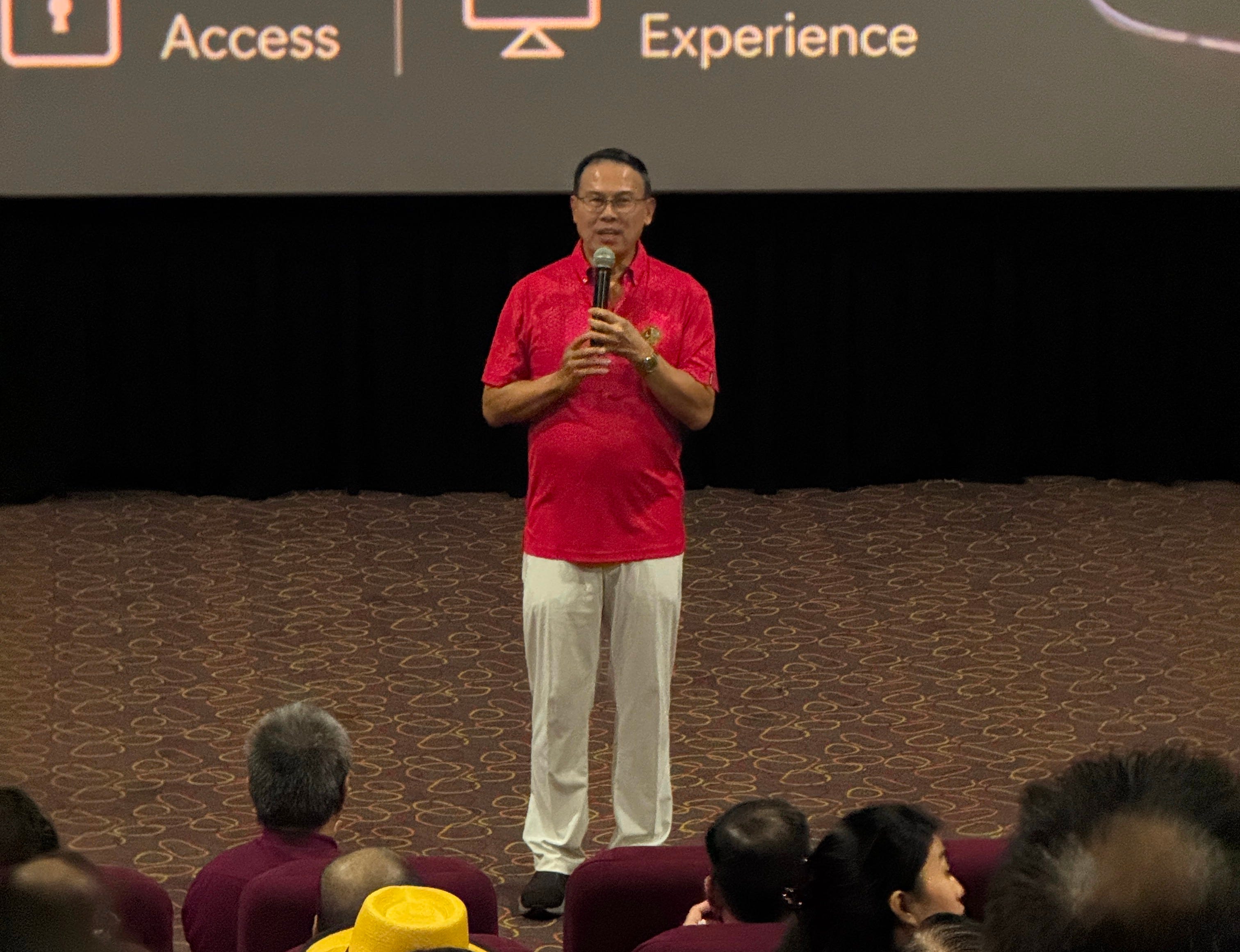
The screening was attended by former Northwest Community Development Council Mayor Dr Teo Ho Pin. In his introductory speech, he hoped that the film would “inspire our people to look to the future,” citing the creation of the National Space Agency of Singapore in April 2026. All this writer can afford is to wonder how so much investment and grants are being made into AI storytelling, when its output is regressive and primordial relative to the filmmaking efforts of the last three decades.
It was depressing walking out of the cinema, especially after a poorly-hosted Q&A session that largely ignored questions from the back half of the theatre and took praise from the invited guests in front. It was all the more sobering considering our policies that now heavily invest in generative storytelling.
Contrary to a FizzDragon’s representative who articulated the aims of the company to tell stories “cheaper, better, faster,” and compromised on errors and mistakes in the film just to premiere on August 9, 2026, perhaps the creators ought to slow down and reflect on their intentions, storytelling and craft before traumatising us all with these devilish creations. We have survived three decades without AI filmmaking, we can survive many more without it.
Written by Daryl Cheong, edited by Phyllis Chan

