

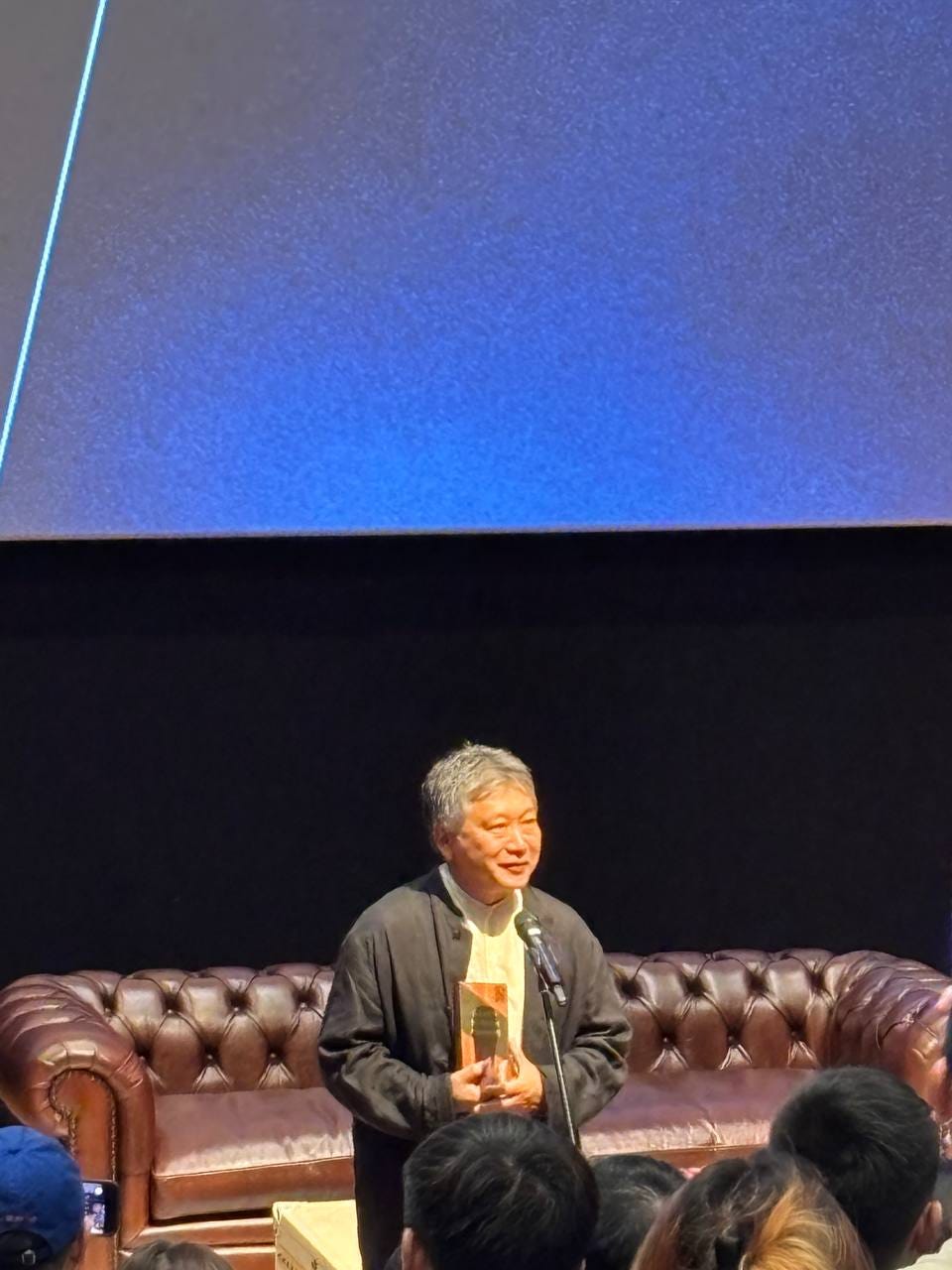
“This feels like a graduation. I haven’t done much yet. So I want to go much further.” This was what Japanese filmmaker Hirokazu Kore-eda had to say when receiving the SGIFF Cinema Honorary Award, the festival’s highest accolade. While everyone was intent on looking back upon Kore-eda’s remarkable career and enduring contributions to cinema, Kore-eda himself seemed keen to keep moving.
Reflecting back on his storied career, Kore-eda spoke at length about his influences, and in particular, his reverence for Hou Hsiao-hsien. “Have you had the chance to meet him?” Kore-eda asked fellow filmmaker and moderator Boo Junfeng about his encounters with Hou Hsiao-hsien. “He has such charisma. I am in complete admiration.”
Kore-eda then spoke about how Hou’s early works influenced his approach to scene construction and composition. “I admired his earlier works in terms of the spotlight,” Kore-eda remarked, “It’s not just for the human, for the character, but everything surrounding the human. Everything in life has the same value as a human being.”
When asked about his early works, Kore-eda expressed embarrassment and regret. “When I watch my older films, it gives me a bit of an itch,” Kore-eda says. He felt that he had worn his influences too plainly, and in turn, could only see how much it failed to match up to the originals that inspired them. In particular, he regretted how his films were too structured and left little to no room for improvisation during the process of shooting.
Speaking on the theme of the family unit and the parent-child relationship in Kore-eda’s works, the director wistfully recalled the passing of his father and how the absence of such a figure led him to think more deeply about the role that parents play in the life of an individual. “In 2000, my father passed away. And after that, my mother died too, which made me nobody’s child at that time. So I was really questioning myself on what is family?”
“I did not intentionally put this in my films,” Kore-eda remarked. “But looking back, I feel it might have been affected as well.”
When asked about the prominence of the child’s perspective in his works, and his experience with child actors. Kore-eda harped on the importance of flexibility and of getting to know the child and shaping the film around them, rather than the inverse. “Just look for the bird, and it’ll happen,” Kore-eda quotes, speaking to Ken Loach’s approach to capturing naturalistic performances in his film Kes (1969). “The ideal shoot is one where the child is excited to return tomorrow.”
Speaking on what was ahead for Kore-eda, he expressed similar sentiments from the beginning of the dialogue. “The second half of my career is about to begin,” Kore-eda remarked. “I have already begun writing a screenplay for next year, preparing for this second half of my career.”
Written by Adrian Ho, edited by Phyllis Chan