

What must we sacrifice for the convenience of seeing the world at our fingertips?
Shaheer Tarar’s video-game lecture-performance, The Compression Zone, attempts to answer this question by making visible what remains unseen in our digitally mediated world. Across three acts, Tarar moves between the personal and the geopolitical, from his early encounters with the Internet to the militarised gaze of satellite surveillance. What initially appears to be a playful excursion into a colourful, low-poly world gradually reveals a more unsettling proposition: the technologies through which we perceive and understand the world are never neutral.
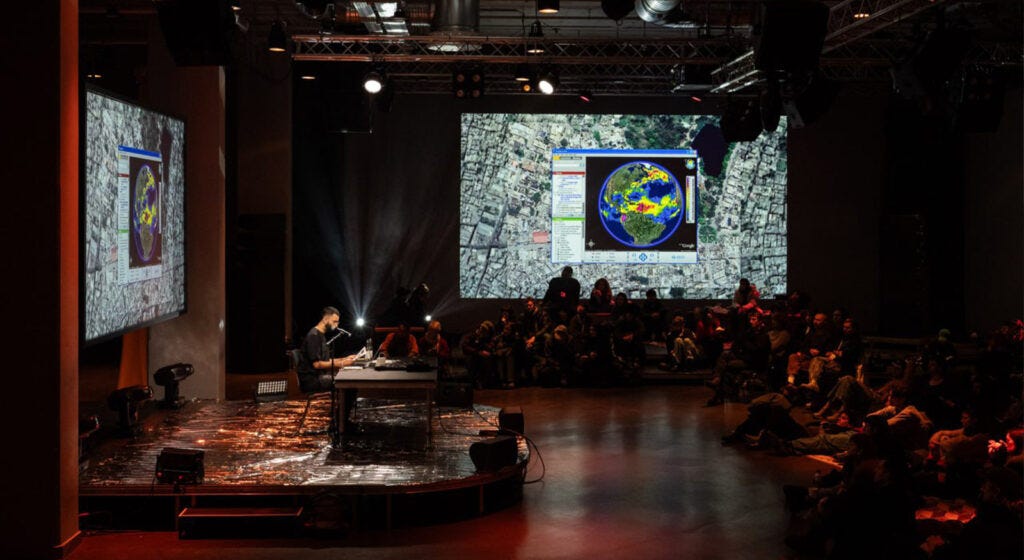
During the post-performance Q&A, Tarar explained that his interest in compression emerged from his research into the cartography of the Partition of India. The borders drawn by British colonial authorities relied on maps that privileged railways, telegraph networks and military infrastructure over the villages and homes of those who inhabited the region. What appeared to be geographical representations were already a selective account of the world, shaped by the priorities of those who produced them.
The relationship between representation and power forms the basis of the performance’s first act, which introduces the titular “Compression Zone” through the act of consumption. As the game’s protagonist swallows food and the people around him, Tarar draws a parallel between consumption and comprehension: to understand something is to reduce it to a form that can be assimilated into existing frameworks of knowledge. A funnel-like device becomes a visual metaphor for this process, reducing a person to an identity card, and the world to a map. In both instances, complexity is sacrificed for legibility.
This tension between visibility and erasure becomes more pronounced in the second act, which turns towards the digital image. As Google Earth imagery moves across Lahore, the sounds of human activity fill the space, revealing a world that exceeds what the ‘objective’ satellite image can represent. Tarar extends this inquiry through a demonstration of JPEG compression, showing how information kept or sliced up (quite literally) is still determined by “the perceptual limits of the normative human eye.”
Yet compression is not solely an act of erasure. Tarar recalls discovering xmen.com, a former gay pornography site that now re-directed to Marvel’s webpage, as a window into queerness, where pornography became a companion through which otherwise inaccessible desires can be explored. Despite its limitations, the compressed image and the compressed digital world also make new forms of recognition possible.
The third act brings these questions into the realm of warfare. Through EarthViewer, QuickBird satellite imagery and archival news reels of the Iraq War, Tarar traces how technologies of geographical representation become instruments of military surveillance. Civilian infrastructure is stripped of its everyday functions and made legible only through its strategic value. The world is no longer simply observed, but surveyed from the vantage point of a weapon.
There is a certain irony in Tarar’s use of a video game to interrogate technologies implicated in warfare. Yet its playful aesthetics belie a more disturbing reality: the same infrastructures enabling us to explore the world can also facilitate its destruction. Maybe it’s time to reconsider our understanding of the world, and admit that our worldviews are “low-poly, low-res artefacts of compression.”
Written by Phyllis Chan, edited by Daryl Cheong