

Everytime begins as a grounded portrait of a family unit in Berlin. The family is made up of two daughters, Jessie and Melli, one on the cusp of womanhood and the other, still a child and a single mother, Ella. The film naturally leans towards themes of sisterhood and details the specific challenges and struggles of growing up in an all-female household, observing the ways in which their lives intersect and overlap one another’s within the sometimes cramped walls of a household. The stillness with which director Sandra Wollner observes these intersections gives meaning to the term “slice-of-life” as her voyeuristic style gives their interactions an effervescent quality. One of these episodes of life sees Jessie and her boyfriend, Lux, hanging out on a rooftop while high on MDMA.
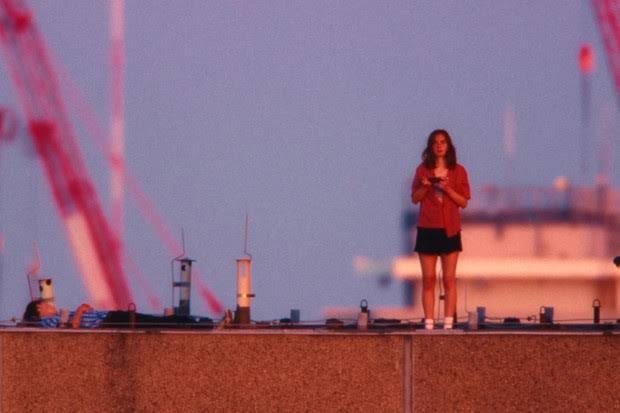
Then it happens: The camera flutters, casually surveying the Berlin rooftops, until a body falls through the frame. The camera doesn’t address this but merely continues in its flight path. Everytime then, launches the story months into the future.
Wollner presents the classic components of a coming-of-age narrative, only to deprive the audience of it. The grounded and naturalist still-life drama is shattered and replaced instead with a treatise on grief and loss. What we feel in this moment isn’t sadness, but an emptiness and a distinct feeling of absence. Wollner’s audacious choice, in skipping through the cinematic tropes of the immediate aftermath, and in framing the death of Jessie not with melodrama but with a detached neutrality, helps to set audiences into the precise wavelength of the surviving characters in the film.
The brief glimpses into the lives of this family become a haunting reminder of what used to be, and as the narrative follows them through their journey of grief, we can palpably feel the absence of what once was. Through Melli, Ella, and Lux, we are given insight as to how different people deal with the emotion of grief and how tragedy can form connections that hold stronger than blood. Everytime depicts the tension between remembrance and moving on, capturing the encircling and inescapable quality of grief.
Grief gradually dissolves the contours of the physical world in Everytime, and the film takes a turn into the surreal as the digital world, memory and the physical merge into one reality. Wollner deploys magical realism and digital realism as an expression of the feeling of infinite suspension, capturing how grief can remain with us long after the tragedy which bestowed it.
The title Everytime calls to the concept of simultaneity, and Wollner designs a finale which allows for multiple emotional realities to exist at once. Past, present and the infinite possibilities of the digital collapse into one, and we are given the chance to make our own judgement: Is this all a miracle or just a comforting illusion?
Written by Adrian Ho, edited by Daryl Cheong