

There has been some buzz surrounding Nelson Yeo’s The House on the Moon. Billed as Singapore’s first feature-length wuxia film, it is an ambitious undertaking of the Chinese myth of Hou Yi and Chang’e. According to legend, the archer Hou Yi shot down nine of the ten suns scorching the earth, earning an elixir of immortality as a reward. His wife, Chang’e, eventually consumed the elixir and ascended to the moon, where she would remain separated from her husband.
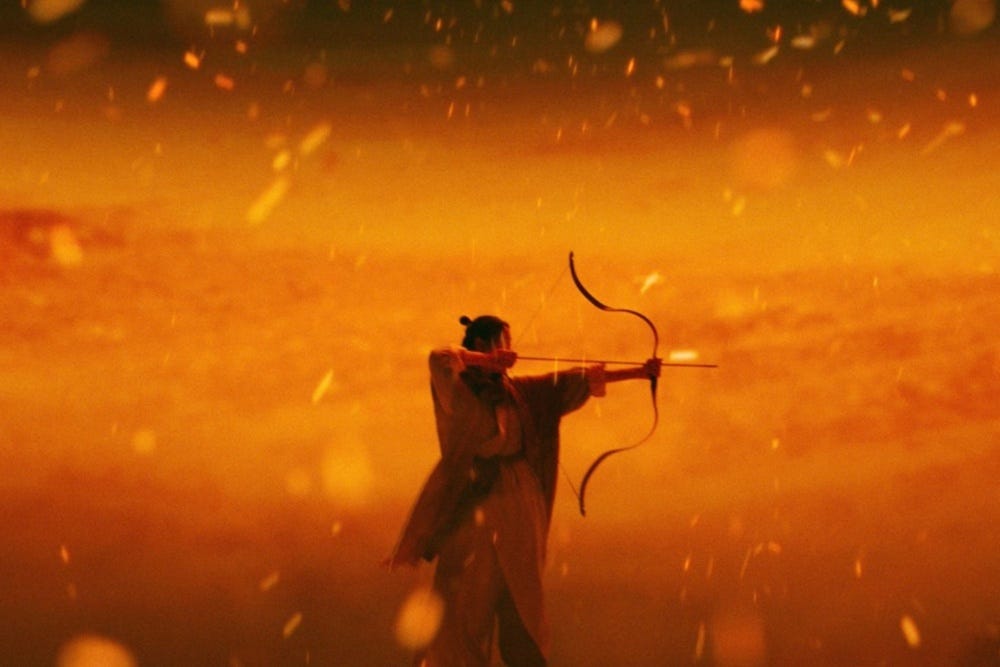
Combining science fiction and wuxia, Yeo transforms this familiar mythology into a world that seems to exist outside any recognisable time or place. The film moves between the ancient and the futuristic, blending temporalities and geographies until it becomes difficult to pinpoint precisely where, or when, the story unfolds. Yet this ambiguity feels deliberate. Yeo is less interested in reconstructing a particular historical period than in creating a world governed by its own visual and emotional logic.
And what a world it is. Visually, The House on the Moon is stunning. Its atmospheric compositions and hyperstylised fight sequences are evocative of Wong Kar Wai’s Ashes of Time (1994), where the conventions of wuxia become a means of exploring longing, desire and memory. Like Wong, Yeo appears more concerned with establishing a mood than delivering conventional action spectacles typically associated with the genre. His characters drift through landscapes that feel suspended between dream and reality, their relationships shaped by forces that seem to transcend time itself.
Particularly intriguing is Yeo’s decision to complicate Peng Meng’s (Harry Chang) character through a queer relationship, culminating in the tragedy of having to kill his own lover (Edward Tan). In a genre traditionally preoccupied with masculine honour, loyalty and martial prowess, this introduces another dimension to the character’s emotional life. Love becomes inseparable from violence, and the conventions of wuxia offer a framework through which these contradictions can be explored. Yet one wonders whether Peng Meng’s lover exists as a character in his own right, or merely as a means of heightening the tragedy of Peng Meng’s story.
Unfortunately, the film’s performances struggle to sustain the world that Yeo has so meticulously constructed.
Dominick Rustam, who plays Hou Yi, and Lim Shi-An, who plays Chang’e, are undeniably beautiful to look at. Yet the moment they begin speaking, the illusion begins to unravel. Rustam’s best efforts at speaking Mandarin and Lim’s distinctly Singaporean accent sit awkwardly within the film’s stylised universe, particularly when they are required to deliver lines in classical Chinese. There is something almost unbelievable about hearing such language delivered without the fluency or conviction that the film’s heightened register demands. Rather than drawing me further into its mythology, these moments repeatedly reminded me that I was watching actors performing roles.
Meanwhile, seasoned veteran Lee Kang-sheng delivers a disappointingly lacklustre performance as the God of Love. Lee delivers his lines without the emotional gravitas needed to sustain the film’s heightened dramatic atmosphere. Of the ensemble, I found Singaporean arthouse regular Doreen Toh’s performance as Yin Yuan the most convincing. She seems to understand precisely what kind of film she is in, delivering a performance that complements its peculiar atmosphere rather than disrupting it. There is a certain theatricality to her performance, but unlike her fellow cast members, she manages to inhabit the film’s heightened world without appearing out of place.
Perhaps this is what makes The House on the Moon so frustrating. Yeo’s vision is unmistakable, and there is much to admire in his willingness to push beyond the conventions of Singaporean cinema. Yet for a film so dependent on atmosphere, the performances become an especially glaring weakness. Its images invite us into an extraordinary world, only for its actors to repeatedly pull us back out of it. Nevertheless, The House on the Moon deserves to be seen on the big screen. Its breathtaking art direction, editing and cinematographic choices alone make it a remarkable visual experience, even if its performances struggle to live up to the world Yeo has so meticulously constructed.
Written by Phyllis Chan, edited by Daryl Cheong