

In the vein of Oliver Stone’s JFK (1991), The Assassin(s) (dir. Hur Jin-ho, 2026) uses conspiracy to conjure an epic political thriller in an attempt at the truth. This form is all the more necessary where the real-life assassination of South Korea’s first lady, Yuk Young-soo, in 1974 had raised questions in the decades that followed. Six bullet shots were heard, but only four were possible. Moon Tae-kwang (Park Jeong-min), the film’s alleged assassin based on the real-life Mun Se-gwang, had five possible rounds: one misfire and four strays. When official accounts are contradicted, the film’s protagonists interrogate whether the assassination of Yuk would have been reasonable, let alone possible.
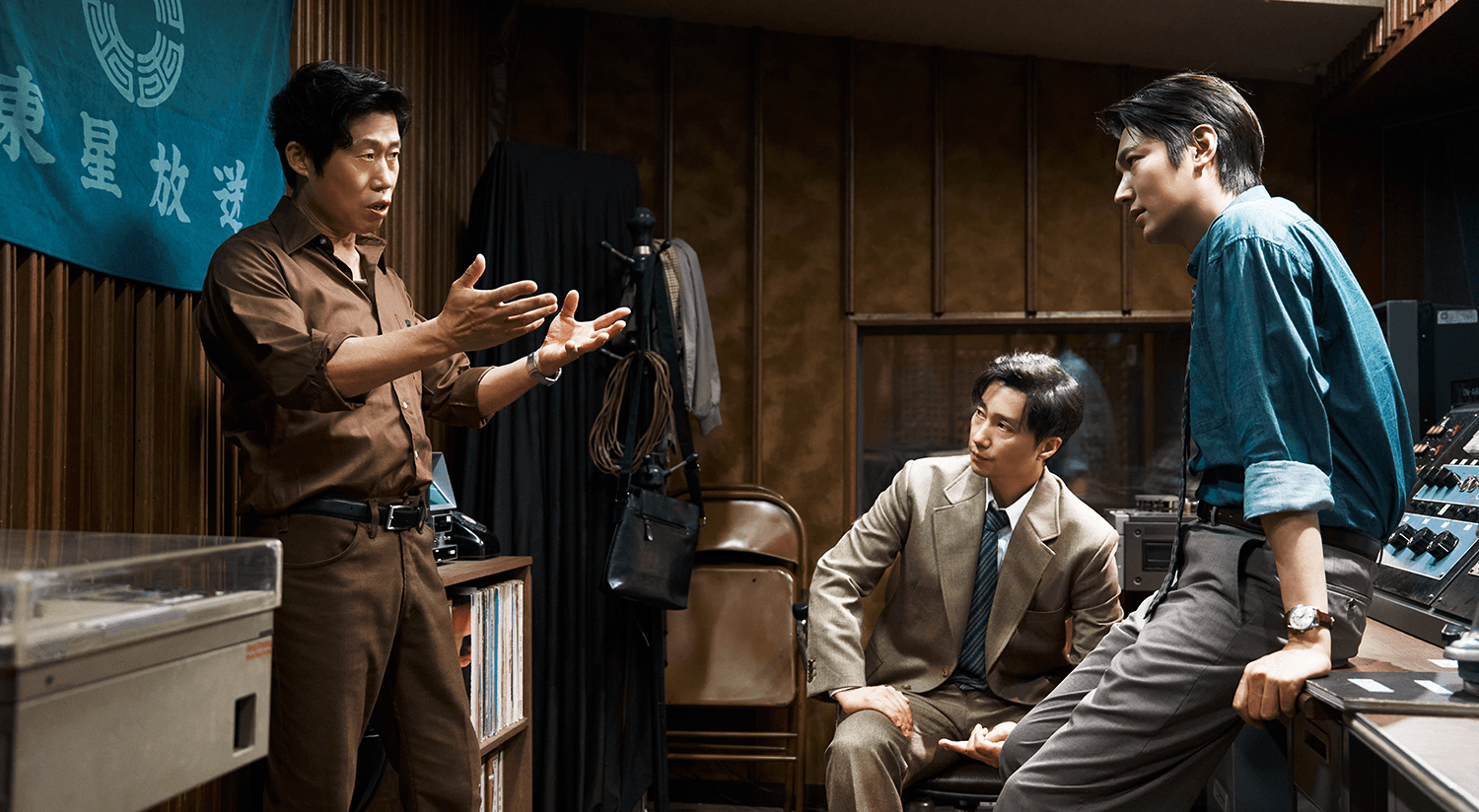
Leading an ensemble of well-meaning journalists and policemen devoted to the nation and truth, the trifecta of protagonists amalgamate into a revelatory Korean psyche. Park Cheol-gu (Yoo Hae-jin), as the police superintendent whose by-the-book securing of the National Theatre where the assassination occurred, represents the common man whose disillusionment with the system’s corruption compels one to action. Kim Jae-hwan (Park Hae-il), a newspaper editor continually under threat, is an Übermensch whose ideals of integrity and independence inspire revolt against censorship. Finally, Han Young-il (Lee Min-ho) is a nepo baby journalist whose coincidental presence at the event propels him into the pursuit of truth. The disillusioned, the elite, the young united in truth.
The film is certainly rousing. Reminiscent of the atmosphere and courthouse parallels to the miniseries Chernobyl (dir. Craig Mazin, 2019) and the urgency of Spotlight (dir. Tom McCarthy, 2015), the film’s dramatisation underscores the ideals of truth and the shortcomings of a society for and by the powerful. Director Hur makes every moment’s stake and importance pronounced: From a question of whether the assassination was intended for President Park Chung-hee or his wife Yuk Young-soo and therefore manufactured for faux patriotism in a time of national crisis, The Assassin(s) turns to the economic consequences of Japan-Korea partnerships, imperialism, and corruption. A real-life-inspired sequence of free press declaration uses cross-cuts and close-ups to evoke the same spirit of the French Revolution. The dramatic prowess is undoubted.
Yet, for a political thriller, its meandering pacing led to a dry beginning more concerned with recreating facts and a faithful play-by-play recreation of the assassination. Change, in both plot and rhythm, occurs only when the trifecta decides to take action around the film’s midpoint. It is also a missed opportunity to develop the protagonists’ contexts that inform their belief systems in pursuit of the truth. In an age of untruths, it is perhaps less important that fictional characters take action and more important why and how an everyman can advocate for truth too. The film risks an elitist perspective, perpetuating an ideology where courage is as elusive and uncommon as justice or the Truth.
The spirit and dramatic intentions of the film are undeniable. Yet perhaps in choosing to entertain rather than to inspire change or reflection, the film risks perpetuating inaction through its uninspiring pacing and gratuitous ideologies. À la Margot (Anya Taylor-Joy) of The Menu (dir. Mark Mylod, 2022), the worst fucking part? I’m still fucking bored.
Written by Daryl Cheong, edited by Phyllis Chan