

The 37th Singapore International Film Festival (SGIFF) opened with a commitment to artistic freedom. In his opening address, Festival Chairperson Boo Junfeng reaffirmed the Festival’s longstanding no-cut policy, defending the sanctity of an “unadulterated connection between the filmmaker’s vision and the audience”. The declaration comes amidst controversy surrounding the Festival’s opening film, The Assassin(s), with conservative groups in South Korea having urged SGIFF to withdraw its screening.
Directed by South Korean filmmaker Hur Jin-ho, The Assassin(s) is a political thriller revisiting the 1974 assassination attempt on then-President Park Chung-hee. Its political subject matter extends beyond the historical events it depicts, with the Festival receiving what Boo describes as a “massive amount of messages” opposing the screening.
In response, Boo emphasised that SGIFF had carefully considered the arguments presented, but ultimately regarded the film as an artistic interpretation of historical events. “We stand by our decision to have the film as our opening,” he declared. When Director Hur took the stage, he expressed his hope in reminding the audience that “people want to seek and expose the truth despite being in an oppressed society.”
Beyond the controversy, the opening address also celebrated developments in Singapore’s filmmaking landscape. Boo highlighted the international successes of local filmmakers, including Ang Geck Geck’s Ah Girl at Rotterdam, Anthony Chen’s We Are All Strangers at Berlin, Nelson Yeo’s The House on the Moon at Locarno, and The Violinist at Annecy. He also welcomed the lifting of restrictions on dialect films in Singapore cinemas. Boo mentions a panel from SGIFF 2025 focused on levelling the playing field for cinemas in Singapore, where the dialect issue was concluded as one of the “lowest-hanging fruits.”
More significantly, SGIFF announced the expansion of its film funding initiatives, supported by the Tan Ean Kiam Foundation through 2029. The Southeast Asian Short Film Grant will support six projects with $10,000 each, while the Southeast Asian Documentary Grant will provide three completion grants of $10,000 for feature documentaries in their final stages of production. Boo also shared about new initiatives such as the Young Explorers Programme introducing relaxed screenings that let children “respond to the films’ themes in fun and meaningful ways.” SGIFF is also partnering with the Cerebral Palsy Alliance Singapore for a special screening of Brave Cats to make cinema “more accessible.”
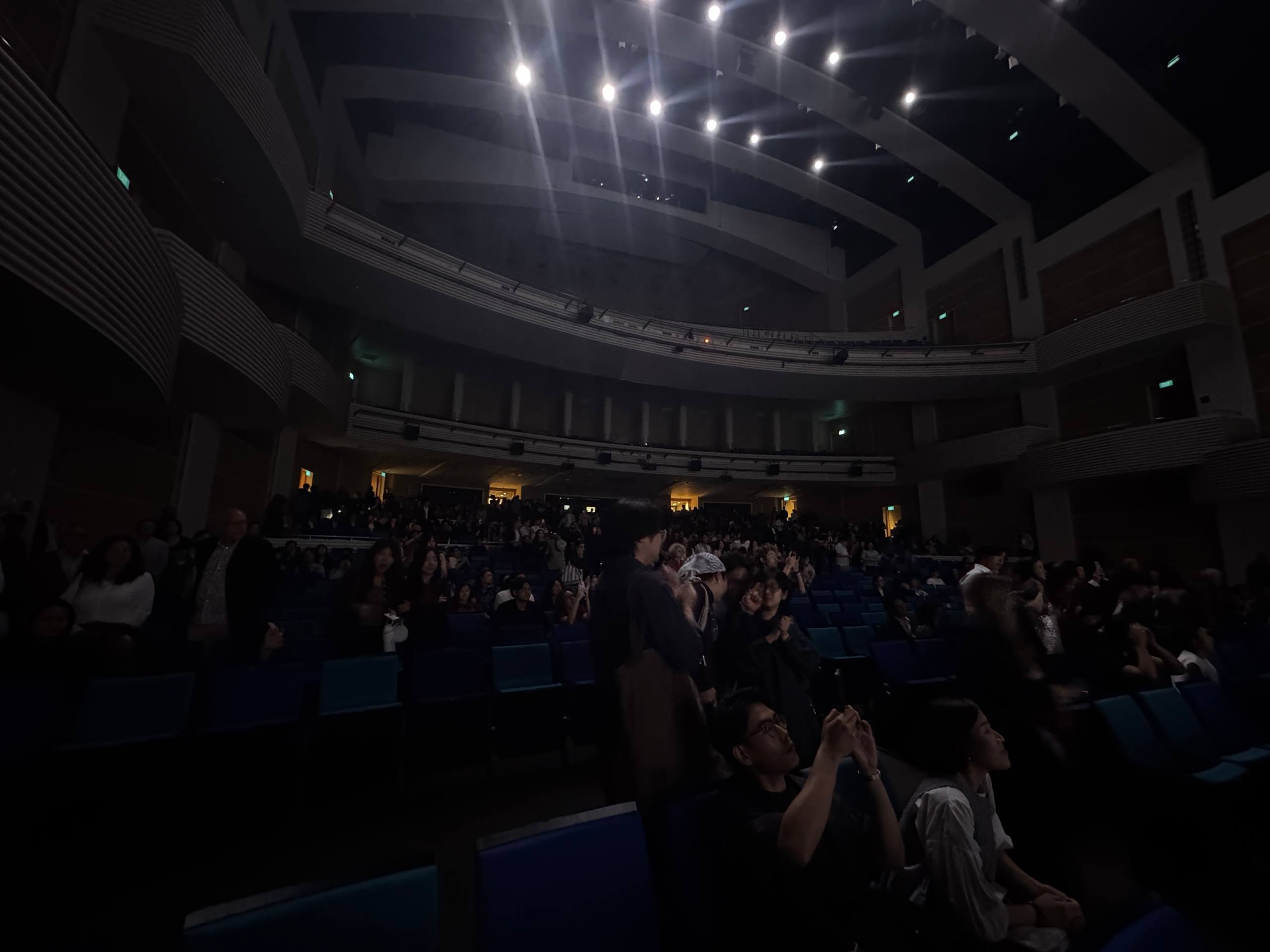
Following the celebratory tone of the Opening Address and exhilaration of the Opening Film, the evening ended on a slightly awkward note. Programme Director Thong Kay Wee re-introduced director Hur onstage mid-credits as most of the audience was already streaming out. Nonetheless, Hur shared an important closing note: “Everyone in the opposition party in Korea wants the film withdrawn, but we stood our ground to screen it. It was a very courageous move, and it shows the spirit of the creatives around the world. We are very thankful to the Singapore International Film Festival for giving us creative freedom and expression for tonight. It is a great encouragement to the producers, filmmakers and actors.”
Reminiscent of Boo’s remarks that “It is not always easy to remain steadfast in the face of pressure,” the Opening frames a festival expanding its offerings and defending its core beliefs.
Written by Daryl Cheong, edited by Phyllis Chan