

Part of the three sections central to the inaugural Objectifs Short Film Festival, ‘Current Frames’ is a “survey on the international short and film scene”. As an opener to both the Festival and section, Hypnotic Bursts presents four short films from the extensive filmography of the duo Caroline Poggi and Jonathan Vinel. Presented as award-winning filmmakers whose works have travelled to major festivals like Cannes, Berlin and Locarno, the expectations are high.
After School Knife Fight (2017) opens the programme with youthful sincerity. Four friends (Laetitia, Roca, Nico, and Nael) are part of a band. However, this routine practice is different: Laetitia will be leaving for her studies. This would therefore be their last. Simple and sweet, the film opts for long shots and takes to punctuate the unspoken and uncommunicated desires. Contrasting these, exuberant moments of music and dialogue, bordering on extravagance, exude a poetic sentimentality, highlighting youthful contradictions. Though jarring, the polarities are perhaps sensible for an experience of youth equally heightened and extreme.
Then, an animated baby meets a live-action world in Baby Anger (2020). Vulgar, lost and estranged from his family, the titular baby ruminates on how his left nipple resembles his father’s and his right resembles his mother’s, oscillating between the nihilism of “I want to die” and self-aggrandisement of “I am Baby Anger!” This polarity recurs as a motif in Poggi and Vinel’s work, suggesting that such uncertain extremes are inevitable for a young person still finding their place in the world. All we have instead are the brookie recipes that comfort the Baby and appear at length in the credits.
From youthful uncertainty, the programme (and the duo’s filmmaking) becomes more violent and exasperated. The third film Watch the Fire or Burn Inside It (2022) introduces a woman who “chooses to care for the earth by burning it.” The film extends cauterisation into a metaphor for the world: rebirth and change through fire. Whilst the playful form emblematic of Poggi and Vinel continues here with a musical-esque opening singing the protagonist’s hopes to burn those they do not like or who have wronged them, the filmmakers’ increased engagement with socio-political realities introduces ideologies worth examining. Here, one wonders whether the eccentricity of chaos is more shock-inducing than genuine reflection, as they remark: “Is there a world I don’t want to watch burn?” Does one burn out of “care” or the desire to burn?
Finally, the most caustic of their works: How Are You? (2025). Animal personas become transhuman representations of archetypes as an isolated group of animals grapple with the ills of modern day. There, thinly-veiled metaphors for immigration, inequality, and self-help are philosophical meditations, allowing evocative one-liners like “shaking my ass feels fucking great” to exist on the same plane as “art is made by rich kids who don’t need money.” Chaotic and inexplicable, the divergent intellectual threads are less sensible individually, and more coherent when taken as an experience: the world is too full of ideas and thinking. It is unsurprising, then, that the film’s climax is resolved with a rave. To favour the experience of overwhelm over the logic of argument could perhaps render the filmmakers’ ideas superficial––though this personal preference is perhaps more reflective of an audience’s negotiation between ideas and action.
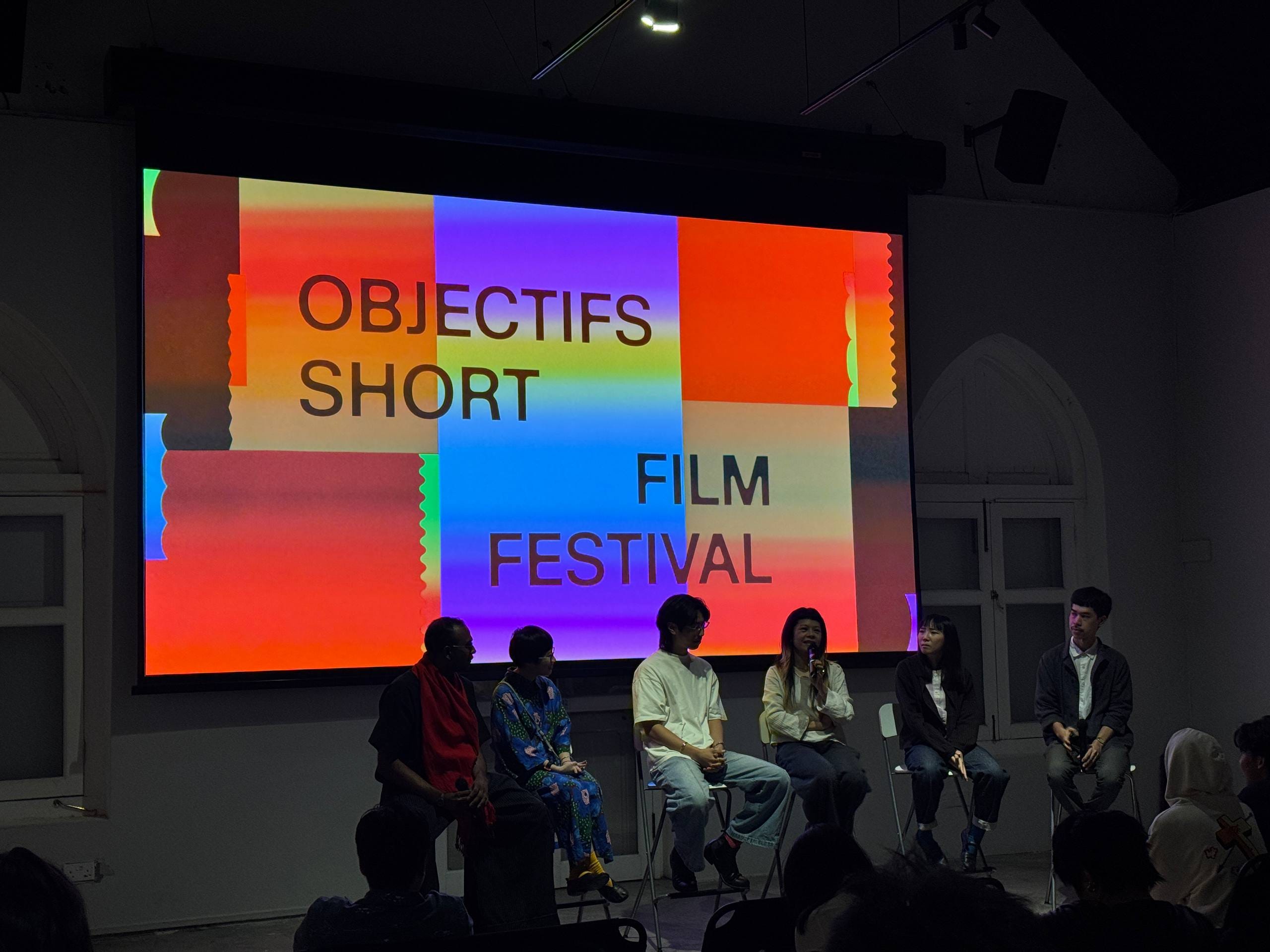
Following the screening, filmmaking couples Jake Low and Shaista Dinis (relationship of 14 years), and Grace Song and Alexander Lee (of 12 years) took the stage.
Programmer-moderators Leong Puiyee and Viknesh Kobinathan framed the conversation around creative collaboration by couples. Leong describes the “joy, anger and mess” of such collaboration, strangely reminiscent of Poggi-Vinel’s films.
Throughout the conversation, the two couples offered contrasting approaches to collaboration: where Low and Dinis embrace an almost inseparable creative process, Song and Lee have learnt to negotiate their differences through a clearer division of responsibilities. What unites them, however, is an understanding that collaboration need not mean agreement. Perhaps this is equally true of Poggi and Vinel’s cinema, where tenderness and violence, sincerity and absurdity, despair and exhilaration coexist without necessarily reconciling. If their films are sometimes frustrating in their refusal to resolve these contradictions, they are also reminders that neither art nor relationships need to be entirely sensible to endure.
Written by Daryl Cheong, edited by Phyllis Chan