

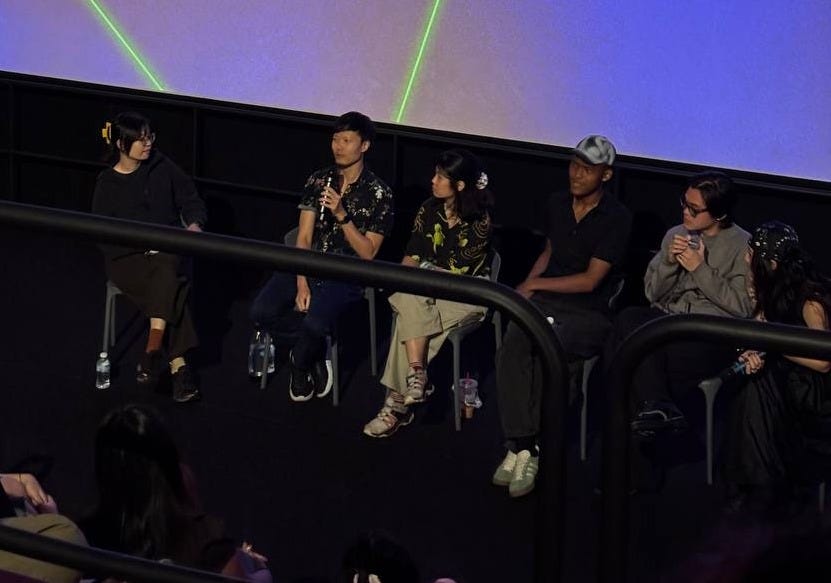
“I liked this section much better than yesterday’s,” remarked an audience member during the post-screening Q&A for Singapore Panorama Shorts Programme 2: “Second Life, Second Skin.” The audience member attributed their preference to the programme’s lighter tone, although the five films arguably explored heavier subjects than those in Programme 1, ranging from toxic masculinity and sexuality to adolescence and personal loss. During the Q&A, the filmmakers shared the personal experiences and creative impulses that shaped their works, revealing how familiar subjects could take on unexpected forms through horror, magical realism and experimental filmmaking techniques.
For Leon Cheo, Orang Minyak marked his first foray into horror filmmaking, having previously worked primarily in drama and comedy. Drawing on the Orang Minyak, a mythological figure from Malay folklore, Cheo sought to reimagine the creature while subverting audiences’ expectations of its mythology. Despite describing himself as a “scaredy cat,” Cheo was particularly concerned with making the creature convincingly grotesque, working closely with his makeup artists to achieve its organic, unsettling appearance. He also revealed that he was developing a longer version of the short film, with hopes of turning it into a feature.
Moderator and programmer Vess Chua drew parallels between Orang Minyak and Ash Goh Hua’s Subterranea, noting how both films turn to the supernatural or elements of magical realism to explore the experiences of teenagers on the cusp of change. Having lived in the United States for the past decade, Ash reflected on her returning to Singapore, realising that these seemingly ordinary youthful encounters were “actually quite magical.”
Meanwhile, Ewan Leong shared the deeply personal origins of Encik, which emerged from his experiences of loss during National Service and an encounter with a superior officer. These experiences prompted him to reflect on toxic masculinity and the possibility of reform among older generations of men. When an audience member asked about his decision to introduce a romantic relationship between his protagonist and a trans woman, Leong explained that he was interested in exploring the burdens of conventional masculinity. “We are teaching young men how to be better,” he observed, before asking, “But what about the older men?” He described the inclusion of a trans woman and other queer characters as an attempt to introduce alternative possibilities for the character’s future. Concerningly, his explanation positions queerness less as an experience to be explored in its own right than as a means of complicating his male protagonist’s relationship with masculinity.
The conversation also turned towards the tactile qualities of filmmaking, particularly in Shara Tay’s Kiss Me Climax and Syahmi Iman’s REANIMATOR. Iman explained how his fascination with taxidermy emerged from a desire to confront his fear of insects, although translating this impulse into a screenplay proved challenging. “I don’t call myself a writer per se,” he confessed, describing how difficult it was to “speak from the heart” when translating his ideas into a script. Comparing his writing to that of other filmmakers, he jokingly remarked, “I see all the films, and they’re written so beautifully, and I see mine, and I’m like, oh, this is the worst shit ever.”
On the other hand, Tay spoke enthusiastically about her preference for traditional art-making over digital processes. For her, stop-motion animation offered the opportunity to physically interact with her creations, allowing puppets to take on lives of their own. “And once you break that down, it’s this organic conversation that makes you feel so human,” she explained. “And that’s how I feel when I make animation. It’s a very human concept.” Tay also discussed her interest in creating female-centric narratives that challenge prevailing taboos surrounding women’s sexuality. Reflecting on the different standards applied to men and women when discussing masturbation, she explained that she wanted to make such subjects less taboo through her films. “I try my best to make the taboo not taboo anymore,” she remarked, hoping that her work would encourage audiences to have more open conversations.
Across the five films, what emerged was a shared interest in approaching familiar experiences through unfamiliar forms. Whether through folklore, animation or personal recollections, the filmmakers demonstrated how the process of artistic reinvention could offer new ways of understanding the world around them.
Written by Phyllis Chan, edited by Daryl Cheong