


A cute cow named Mojo takes the world by storm.
Capitalising on its cuteness, Moo Magic Dairy is set up to consolidate Malaysia’s farms for profit-building—except for one village: Kampung Semerah Padi, Perlis. There, its farmers resist the expansionist efforts of the “evil company” and aspire to form a co-operative that would allow them to retain the land that has sustained them their whole lives.
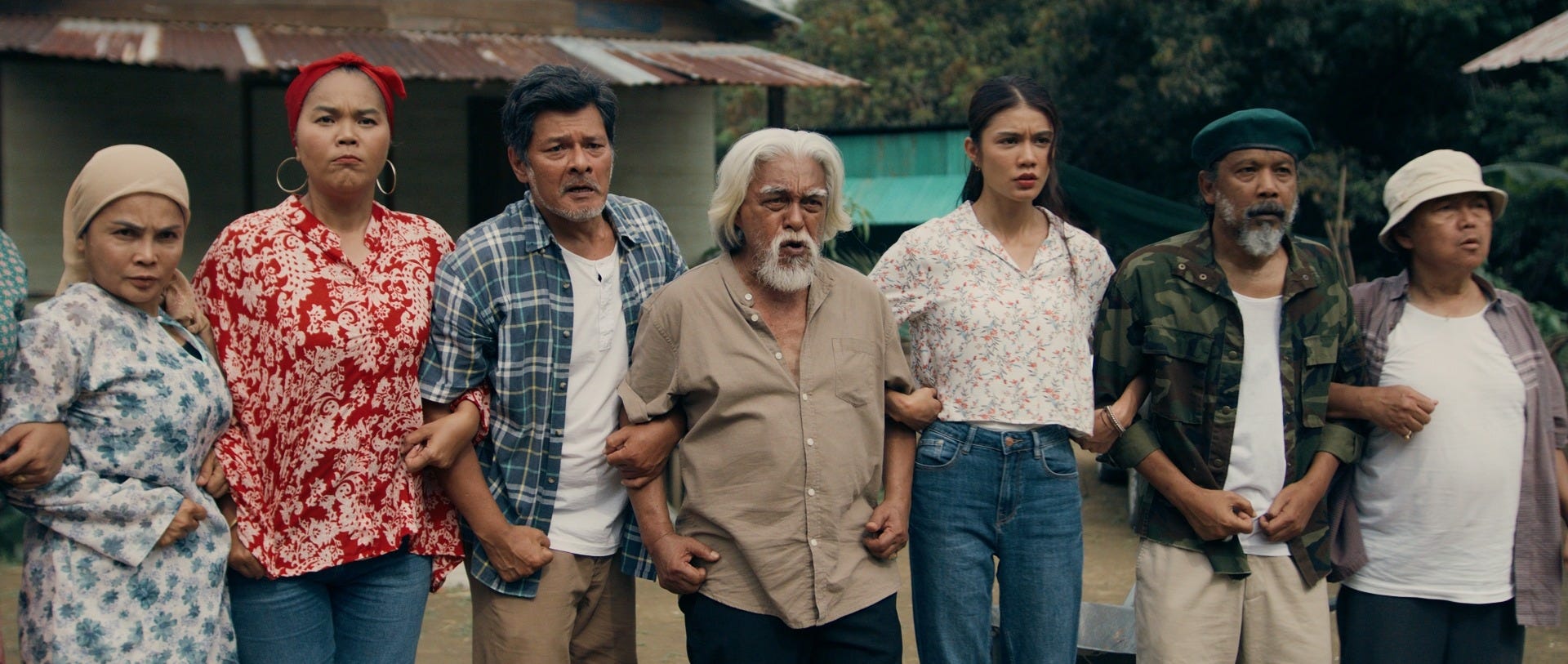
The premise of Mojoku Hilang (2026), literally ‘Finding My Mojo’, uses the comedic convention of mistaken identity to explore its central conflicts between progress founded on economic utility and the traditions of rural “country bumpkins.”
Adi (Adipati Dolken), an ambitious and charming executive at Moo Magic Dairy, hails from Indonesia. After selling his father’s farm, he is recruited into the corporation to expand its business. Pressured by his cunning boss, Dato, to convince the final domino to fall into the corporation’s hands, Adi takes on a false identity of Adam to assimilate himself into the village. There, he develops a romance with a farmer’s daughter, Ayu (Mimi Lana), complicating his agenda.
Lending realism to the film is the ensemble’s remarkable performances. The young leads are supported by veteran actors Wan Hanafi Su (from Apprentice and La Luna) and Dato Tamimi Siregar. Their balance of rich interiority and spirituality, with externalised comedy of errors, creates tonal shifts that can please even the snobbiest of critics. They form an effective central heart of the film, where their characters’ tension between modernisation for commercial benefit and the familiarity of tradition felt realised and true.
The film includes participation by Malaysian, Indonesian and Singaporean cast and crew. Reflecting on this tripartite nature, debut director Min Lim called it a “Nusantara” collaboration during the film’s premiere at GV Bugis+ on 30 July. Nusantara is an Old Javanese term that refers to the Malay Archipelago, which includes Indonesia, Malaysia, and Singapore.
Mojoku Hilang can therefore be read as a love letter to Malaysia and the Nusantara. In Bahasa Melayu and Indonesia, “our homeland” translates to “tanah air kita”, literally our land and sea. The farmers’ acceptance of Indonesian Adi speaks to a regional identity informed not just by one’s land but the seas that unite us.
In the film, a New Zealander investor remarks on Malaysia as a “volatile market” where people are “influenced by sentiments.” As a callback, another local character later remarks that “emotion is what drives decisions.”
Taken together, Lim seems to celebrate the emotional core of being Malaysian (and the larger Nusantara community). Yes, we approach decisions and progress differently, but what’s wrong with that? Here is a pride and desire for regional identity that could be championed more in Southeast Asian cinema.
The film can feel fantastical at times. Plot points conveniently resolve, soundtrack cliches anchor emotional moments, and careless visual effects distract. Yet, if audiences accept the film’s fantastical desires for simplicity, unity, and hope, particularly in hyper-capitalised and nationalistic times such as these, its sentiments feel less like baggage and more like an ideal for our region to aspire towards.
As Min Lim describes her intentions with Head Writer Honey Ahmad:
The film is just “two girls who wanted to make a film that feels good, and remind us of love and hope.”
Select theatrical screenings open in Singapore on July 31, 2026.
Written by Daryl Cheong, edited by Phyllis Chan

