

Following the debut of A Useful Ghost (dir. Ratchapoom Boonbunchachoke, 2025) at Cannes, film discourse revolved around its critique of Thailand’s historical erasure, capitalist exploitation, and bureaucratic traditions. The film’s hauntological engagement pairs with its political discourse to argue how even after death, our past — personal and political — continues to haunt us. Beyond these explorations, a timely and relevant look at the linguistic usage in the film could expose layers of marginalisation perpetuated by Thai society.
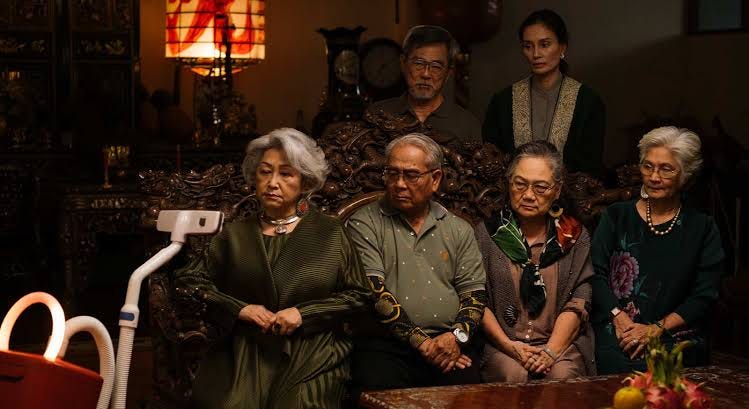
A significant population of Thai-Chinese in Bangkok originated from the Teochew-speaking regions of Southern China. The language represents their heritage, culture and history. In a scene where matriarch Suman speaks to her gay son Mos’s Australian Boyfriend about durian, she speaks to him in Teochew, a rare occurrence in the film. Nonetheless, it evokes familiarity and tradition — reminders of family.
Yet, Mos’s immediate shutdown that “Outside Thailand, no Chinese speaks Teochew anymore” proposes a rejection of these traditional and inherited patriarchal values. While the factual accuracy of this statement remains questionable, its significance lies less in its empirical validity than in the way it dismantles the traditional Teochew family structure depicted in the film. Mos’s remark signals the emergence of a new generation, one whose liberal queerness unsettles the values and hierarchies upon which the family is built.
Ironically, the family also initially rejects him for that same homosexuality, which disrupts these traditions. Only after he proves “useful” to his family does acceptance come.
Across both examples, one’s social belonging is not influenced by identity: whether Teochew or queer, traditional or modern, identity politics does not matter.
Instead, the film proposes that true societal acceptance only comes about with one’s utility within contemporary capitalist society. It is a reminder that Teochew is rejected by modern society not just because it is “outdated” but because it is useless in today’s context.
Beyond Teochew, the Isan language from Thailand’s northeastern region also reveals another marginalised position within the film. Early on, Mos is taken away as a child because matriarch Suman speaks the Isan language instead of Standard Thai. Language is treated visually as a form of contamination where one’s mother tongue could ‘pollute’ a child’s possibility of societal assimilation.
Thai society in Ratchapoom’s film is a homogenous one that sees Standard Thai as the only linguistic possibility. Any deviations from the norm queers one’s assimilation into society and is therefore determined not to belong.
At a point towards the film’s ending, matriarch Suman speaks to protagonist Nat in Teochew. It is a moment stripped of utility, motive and ideology. Instead, language is used purely to communicate one’s appreciation and love for a family member. Using Teochew, Suman accepts Nat as family. In doing so, she repurposes a language dismissed as obsolete, demonstrating the value of language in its capacity to bridge intimacy, kinship and a sense of belonging.
Language matters. In a film plotted around the diction of utility (“Useful”), for one to be accepted into society, the socio-linguistic revelations within the film reveal the marginalisation experienced by the characters. Beyond gender, sexuality, ethnicity, spectral existence, and perceived usefulness, A Useful Ghost suggests that the politics of belonging operates not only through state and bureaucracy, but, more importantly, through the intimate structures of family, language, and everyday life.
Written by Lee Peng Ming, edited by Daryl Cheong and Phyllis Chan