


Speaking following a screening of his film A Useful Ghost at KwanTeo, Ratchapoom Boonbunchachoke echoed the statement by Singaporean Director Ang Geck Geck that being in Shantou felt like “returning home.” As a third-generation Thai whose grandfather left Swatou, Ratchapoom felt a “homely kind of welcome” at KwanTeo.
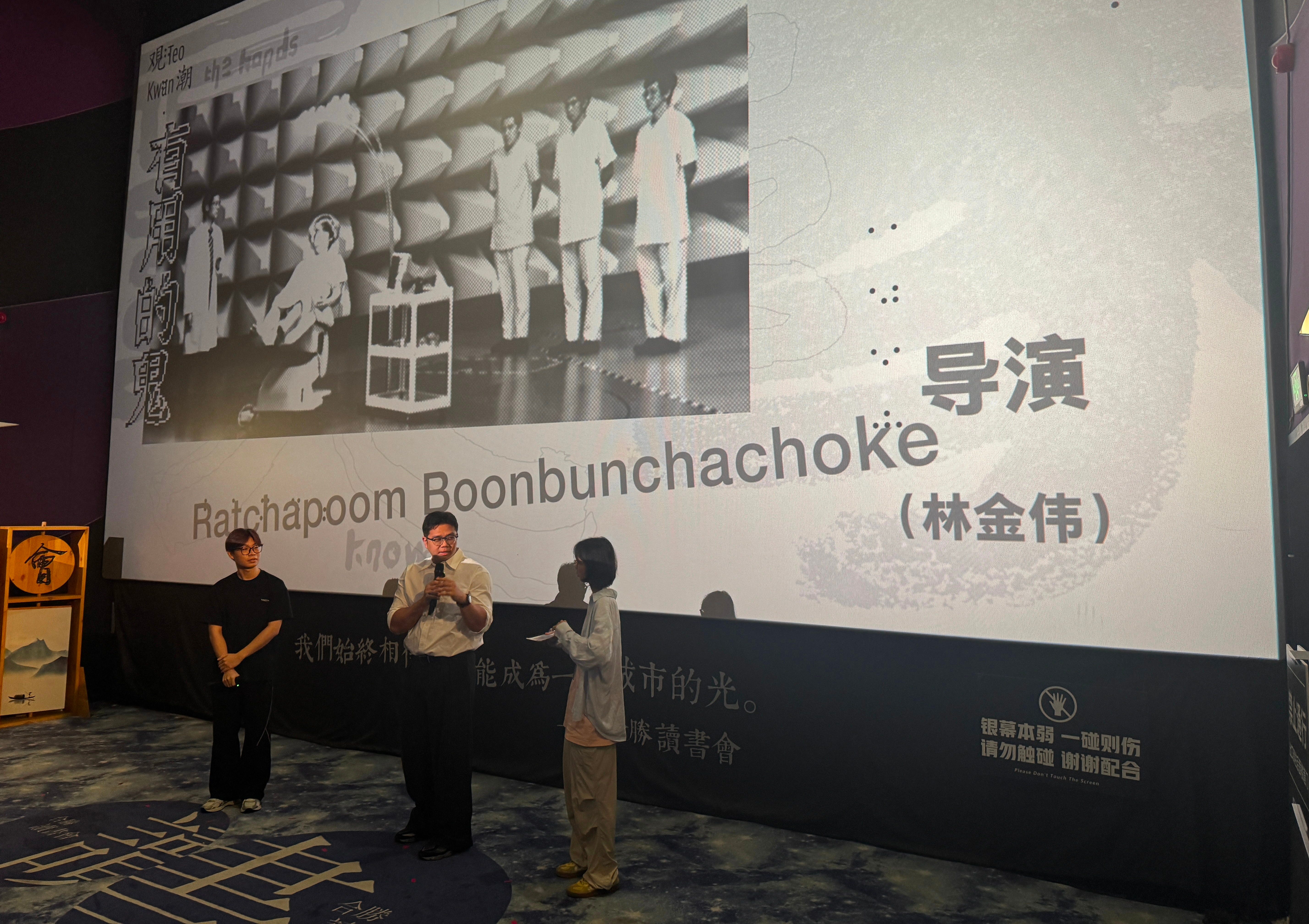
This was the second time the film was screened to a Chinese audience in full since Wuhan in November 2025. The audience was curious whether, and how, it passed Thai censorship. Ratchapoom shared that he was less concerned about the censors’ views on the film’s queer themes and more its depiction of a monk character without propriety.
Asked about his inspiration amidst the film’s many connected themes, Ratchapoom shared that the film originated from a single idea: the Thai folklore story of Mae Nak Phra Khanong (Lady Nak), who died in childbirth while waiting for the return of her military husband. She then existed as a ghost for the father and son, much to the disapproval of society. This legend has been adapted into many Thai horror films.
For Ratchapoom, this reminds him of the queer experience. Just as two individuals are separated by society, so too are queer lovers. He argues that even though Thailand is known to be queer-friendly, discrimination exists. It is reportedly common for parents to tell their children, “You can be gay or lesbian, so long as you are useful.”
This points to the intersectional neoliberal capitalism Ratchapoom critiques in/through his film. Ratchapoom argues that queer Thai individuals subsume their identities to become instruments for people in power, upholding these oppressive systems in turn. Ratchapoom asserts that, similarly, the Chinese people in Thailand attempt to “fit into” Thai society by being useful and therefore valuable to people in power. As such, there seems to be a trend for them to be “conservative” in order to “preserve” the power.
Holding these complex intersections comes naturally to Ratchapoom. When asked if he drew inspiration from Roy Andersson, he shared that he was more inspired by Portuguese filmmaker João César Monteiro, whose film Recollections of the Yellow House (1989) featured visually striking images paired with incredulous dialogue and situations, such as a character asking about pubic hair in their food.
Ratchapoom seems to find inspiration through the juxtaposition of differences. This is also seen in the film’s structure. Asked about the mix of genres, he replied that he likes to surprise audiences.
Otherness is therefore emphasised by Ratchapoom. Asked about the stiff shoulder pads of his female protagonists, Ratchapoom shared that he was inspired by ‘80s women’s fashion, particularly uniforms and office wear, to punctuate their anachronism and how the ghosts do not belong in time and modern society. Its utilitarian nature also points to the capitalist expectation of continued labour, even at death.
Against such oppression, Ratchapoom emphasised the need for imagination. He shared that the final scene of revenge was the natural ethical choice for him. Previous drafts saw unfortunate endings for the characters. He then challenged himself: People in power always win in reality, so “why must our imagination be limited? Why can’t we imagine revenge and how people in power can lose?”
To him, “imagination is an ethical choice.”
Written by Daryl Cheong, edited by Phyllis Chan

