


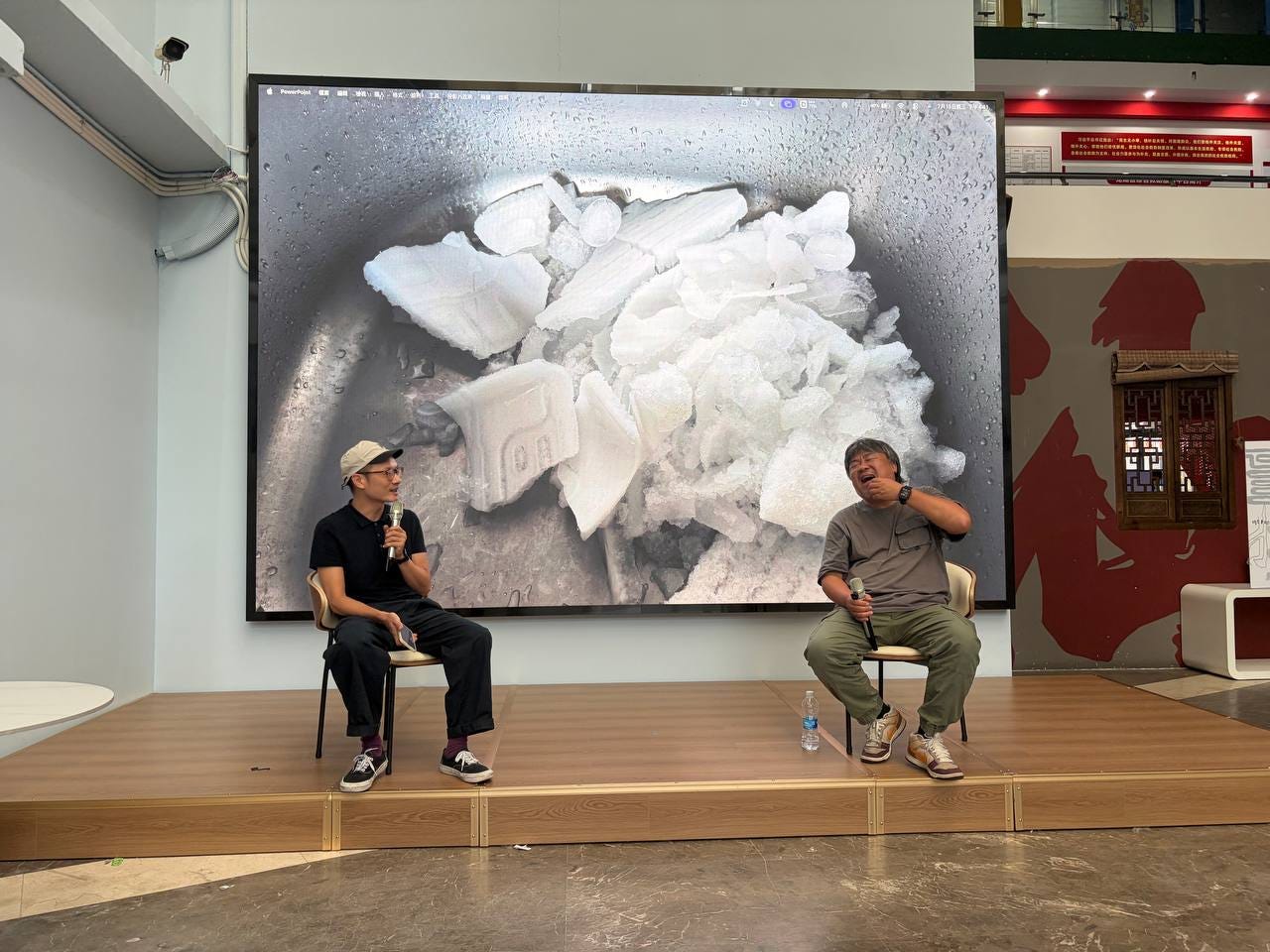
Before Taiwanese documentarian Wu Yao-tung even began speaking, he was already apologising to the audience. Fumbling through his laptop as he arranged his presentation slides, his script briefly flashed onto the screen, complete with reminders of when to pause for laughter. It was an apt introduction to a filmmaker whose presentation would be refreshingly informal, despite grappling with some of documentary cinema’s most difficult ethical questions.
Wu’s presentation unfolded with a montage of his films, tracing his practice from Rui Ming Band (1998) to I’m Here (2021). Rather than explaining his creative process, he questioned whether the idea of documentaries could even be neatly articulated. He argues that documentaries deal with lives that are already messy and contradictory, and that perhaps the form should be seen as an experiment in observing.
Wu posed a series of questions to the audience: How do we observe another person? More importantly, how should we observe them?
After decades of filmmaking, Wu said documentaries did not change the world as he had believed in his naive, younger days. Years spent filming reality taught him that what documentaries could change was the documentarian’s own way of seeing.
Holding a camera, he argued, does not simply bring one physically closer to another person. It draws us into their emotions, vulnerabilities and lived reality. When someone begins suffering before the lens, the filmmaker is inevitably confronted with an ethical dilemma: should one continue filming, and if so, is one prepared to bear the consequences of that decision?
Drawing on his experience serving as a juror at numerous film festivals, Wu lamented that many contemporary documentaries prioritise concept over people. He remembers immaculate compositions, carefully considered camera angles and striking visual design, yet often struggles to remember the individuals at the centre of those films. Too frequently, he said, he sees the director rather than the subject.
Looking back at his own early works, Wu admitted that he could no longer make films in quite the same way. He described his younger self as more naive and insistent in understanding others through questioning. Today, he seeks something different. Rather than interrogating his subjects, he hopes to accompany them, allowing his documentaries to become spaces where filmmaker and subject can eventually meet one another.
It was a philosophy that would be tested immediately.
After the presentation, a Chinese journalist questioned Wu about his treatment of Tom, the protagonist of Swimming on the Highway (1998). In the film, Wu portrayed the complexities of Tom living with HIV, and the film’s raw honesty has been examined through an ethical lens of how the camera negotiates its relationship with “vulnerable subjects.”
“Don’t you think you’re using the excuse of making a documentary to bully someone on camera?” She interrogated.
Joe Huang, who was moderating the session, responded by noting that Wu and Tom remained on “good terms” after filming, even meeting for meals together before they lost contact. It was unfair, he argued, to “make assumptions about a relationship an outsider had never witnessed.” Wu echoed the sentiment, explaining that he had known Tom “personally” and that after the film’s release, “Tom publicly shared that the documentary had made him braver.” However, Wu does wonder whether Tom truly believed those words or had simply been trying to protect Wu from the public backlash.
The journalist pressed further. “Don’t you feel any guilt?” In clarifications after, she explained to Refractions that she had to press because she thinks the director “dodged” her questions.
Wu replied that his later documentary, Goodnight & Goodbye (2018), was his “long-overdue apology” to Tom after three decades. Rather than questioning or challenging him again, Wu said he simply wanted to “accompany him” in his final days. The journalist did not appear to have watched the 2018 follow-up.
The exchange concluded with her statement, “Over here, we have a term for someone like you: shameless.” Before Wu could respond, an organiser stepped in, reminding the audience that “personal attacks had no place in the discussion.”
The confrontation left no easy answers. Perhaps, for context, the dialogue session would have benefitted from a prior screening of both films.
Written by Phyllis Chan, edited by Daryl Cheong and Lee Peng Ming