


For Malaysians, May 13, 1969 is a date they have been compelled to forget, but one that refuses to be forgotten.
Although she was only three years old at the time, my mother, who grew up in Muar, Johor, still remembers the anxiety that settled over her family as they discussed moving south to Singapore to escape the bloodshed unfolding further north. Like many Malaysians today, her memories of that day only survive as fragments, an inherited fear that she can’t let go of.
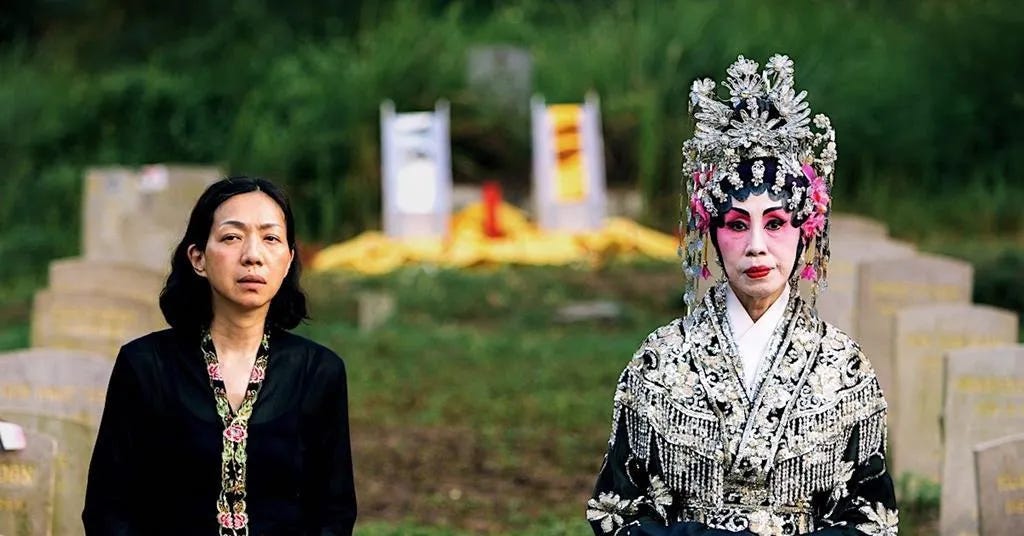
Watching Chong Keat Aun’s Snow in Midsummer (五月雪, 2023), I found myself gripped by that same quiet dread. Wide shots and overhead views observe people wandering through the streets, sharing meals at roadside stalls and making offerings at a Datuk Gong shrine, as though an omnipresent being was already aware of what was to come. Knowing the history myself, every mundane gesture becomes unbearably fragile as I was forced to wait for an inevitable violence.
The film’s first chapter, “Dou E”, takes its name from the wrongfully executed heroine of the Cantonese opera Snow in Midsummer (六月雪) — the source of the film’s English title and a subtle play on its Chinese one (i.e. The opera referenced June, whilst the film points to May, the month of “the Incident” in Mandarin). Rather than reconstructing “the Incident”, Chong beckons audiences to imagine it. As the opera singer performs atop the Majestic Theatre in Pudu, lamenting Dou E’s injustice, the smoldering amber of flames glow ominously behind her to allude to the riots that characterised May 13. Later, Ah Fong’s breathless voice calls out for his mother, father and sister from the back of a lorry, as the camera lingers only on the blood dripping from its tailgate, leaving audiences to imagine the multitude of bodies packed within. The horror lies in what remains unseen, as we are forced to construct the image of violence ourselves. Yet is such violence even possible to imagine?
Peculiarly, the film focuses less on “the Incident”, but more on in its afterlife. We often think of violence as a singular, spectacular event, but Chong turns his attention to the lingering consequences — the trauma that wedges itself into everyday life and the strange suspension of time experienced by those left behind.
The second chapter follows Ah Eng, Ah Fong’s sister, who leaves her domineering husband in Penang and travels to Kuala Lumpur in search of the graves of her father and brother. Clad in her mother’s kebaya (a traditional Peranakan clothing) and armed with an oversized red handcarry, she sticks out like a sore thumb in the contemporary city, as though she had stepped directly out of 1969. Kuala Lumpur no longer bears any trace from her childhood, but Ah Eng’s time has stood at standstill, as she stays rooted to the events of that fateful day.
As a daughter in a patriarchal household, she was largely excluded from her father’s affections and shared few moments with her brother before they were taken from her. However, she becomes the one who bears the burden of remembering. The kebaya inherited from her mother becomes more than an article of clothing, but an heirloom of grief passed from one generation to the next.
When Ah Eng finally reaches the mass graves at the Sungai Buloh leprosarium compound, and nature has almost entirely reclaimed the site. Thick foliage surrounds the narrow dirt path like wired fences, as if time has attempted to conceal what history could not reconcile in the present.
Therefore, she unknowingly reunites with the daughter of the Cantonese opera singer from the film’s opening, whom she had hidden with on an opera stage on May 13. As the woman performs before her mother’s grave, Ah Eng pays respects at an unidentified grave, writing her father and brother’s names on a fragile piece of paper. Though neither has found the certainty they have longed for, they are no longer alone in carrying their grief.
Near the film’s conclusion, the opera singer’s daughter gently asks Ah Eng, “Will you come back next year?” It is a deceptively simple question. But does finding the graves finally bring closure? Can decades of searching end with the discovery of a burial site? Or does remembrance demand an endless return? Chong offers no definitive answer. Instead, Snow in Midsummer suggests that some histories cannot be resolved — they can only be cared for.
Written by Phyllis Chan, edited by Daryl Cheong