


Following her presentation of her Rotterdam-premiering debut feature Ah Girl (2026) at KwanTeo, director Ang Geck Geck spoke to the audience. As a Teochew descendent, Ang remarked that arriving in Shantou, the warmth of her first meal, Teochew Porridge, immediately made her feel like she was home.
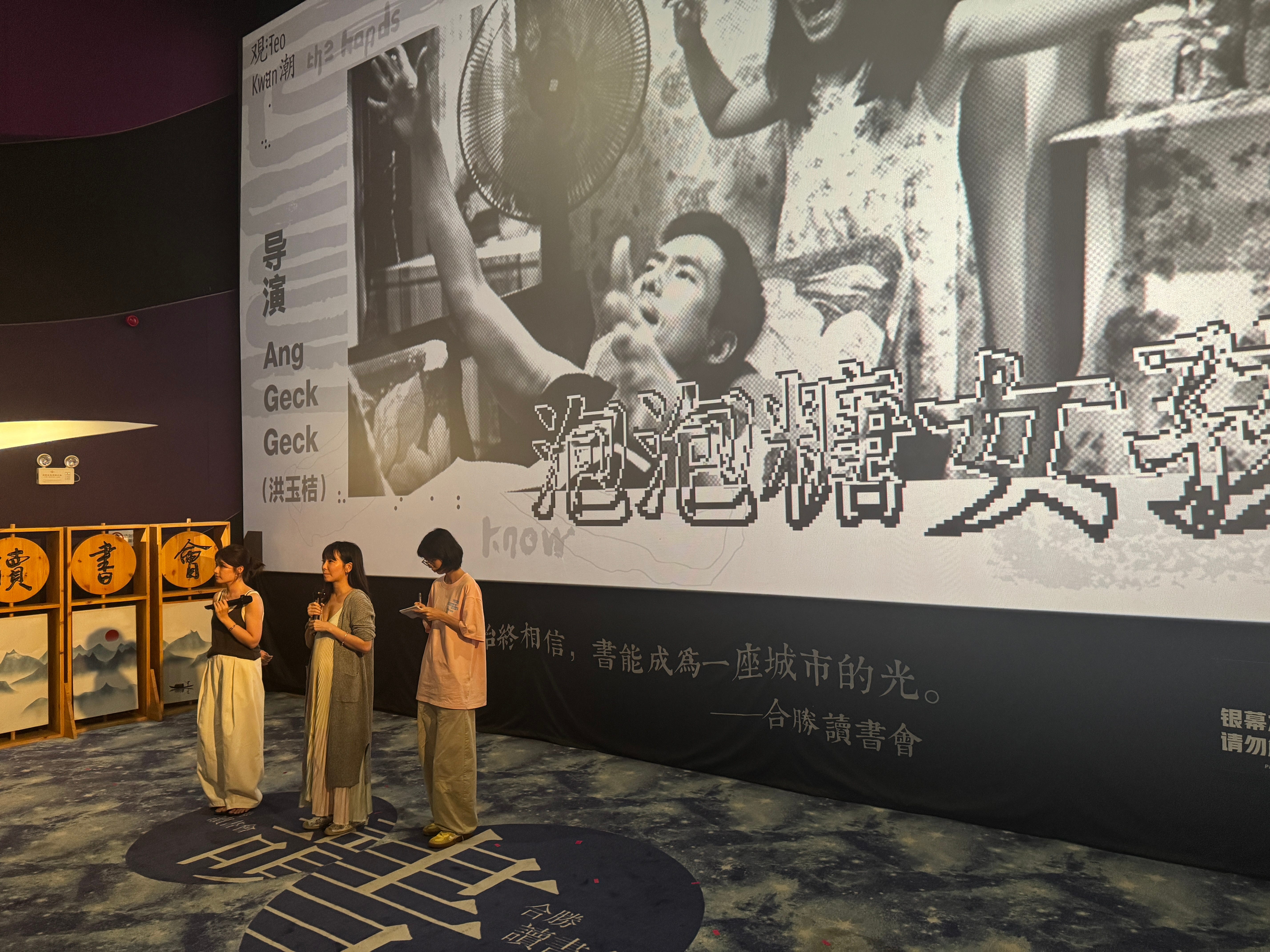
Ang shared that each character of her Chinese name 玉桔 proposes two different colours: emerald (玉) and orange (桔) respectively. Yet, translated into English, both characters become ‘Geck’ and lose their individual essence. Speaking to a Chinese audience that could discern its meaning seemed to allow her name, and therefore her heritage, to be appreciated.
The audience brimmed with curiosity, each individual often asking three to four questions. For an hour after the dialogue concluded, audiences continued to speak to Ang outside the cinema and enthusiastically supported the sale of film merchandise—the first iteration of the film’s sales.
Of note, many Chinese audiences repeatedly asked about the influence of Japanese culture experienced by the Grandmother, portrayed with complexity by Singaporean arthouse regular Doreen Toh.
Related to the central theme of names, Ang was asked about the protagonist’s experience with them. Ah Girl was given many names, and was surprised to find out she has an English one. Ang remarked that this is common in Singapore, where different languages resulted in different names. She uses her own full name as an example: Ang Geck Geck Priscilla Hong Yu Ju. For Ang, what mattered was how Ah Girl chose her own name by the film’s end as a way to reclaim identity.
Audiences were curious about Ang’s process of working with children. Ang shared that she shortlisted a few children to workshop together, allowing them to play freely without adult intervention in order to be their natural selves.Thereafter, upon casting, Ang worked with and visited the families to understand their life experiences. Rather than dictating to the young cast what to do in the given situation, Ang was able to allow them to naturally be themselves across the twenty-day shoot.
This process is symptomatic of Ang’s views of children. This remains a central theme of her film. She encourages adults to treat a child as a person, to recognise that they are naturally curious and to approach them with patience. Just as her film is her hope for her own parents to “understand her perspective as a child”, Ang sees value in not pushing children away.
The film took 12 years to complete. When the project was not initially well-received during the funding process, Ang had cut a trailer to showcase the performances. Asked about her motivation to persist, Ang shared that she saw a “light” and kept following it. For her, belief matters more than passion.
Ang uses the Chinese title, Bubblegum Girl, to make her point. The candy is flexible, and, therefore, resilient. Each time the candy is blown, one can always begin anew and blow the candy again.
Just as how a name is an assertion of one’s identity, candy is symbolic of individual resilience, and the film is the product of one’s twelve-year journey, one is continually reminded of the strength of belief in oneself and the need to journey on.
Written by Daryl Cheong, edited by Phyllis Chan

