


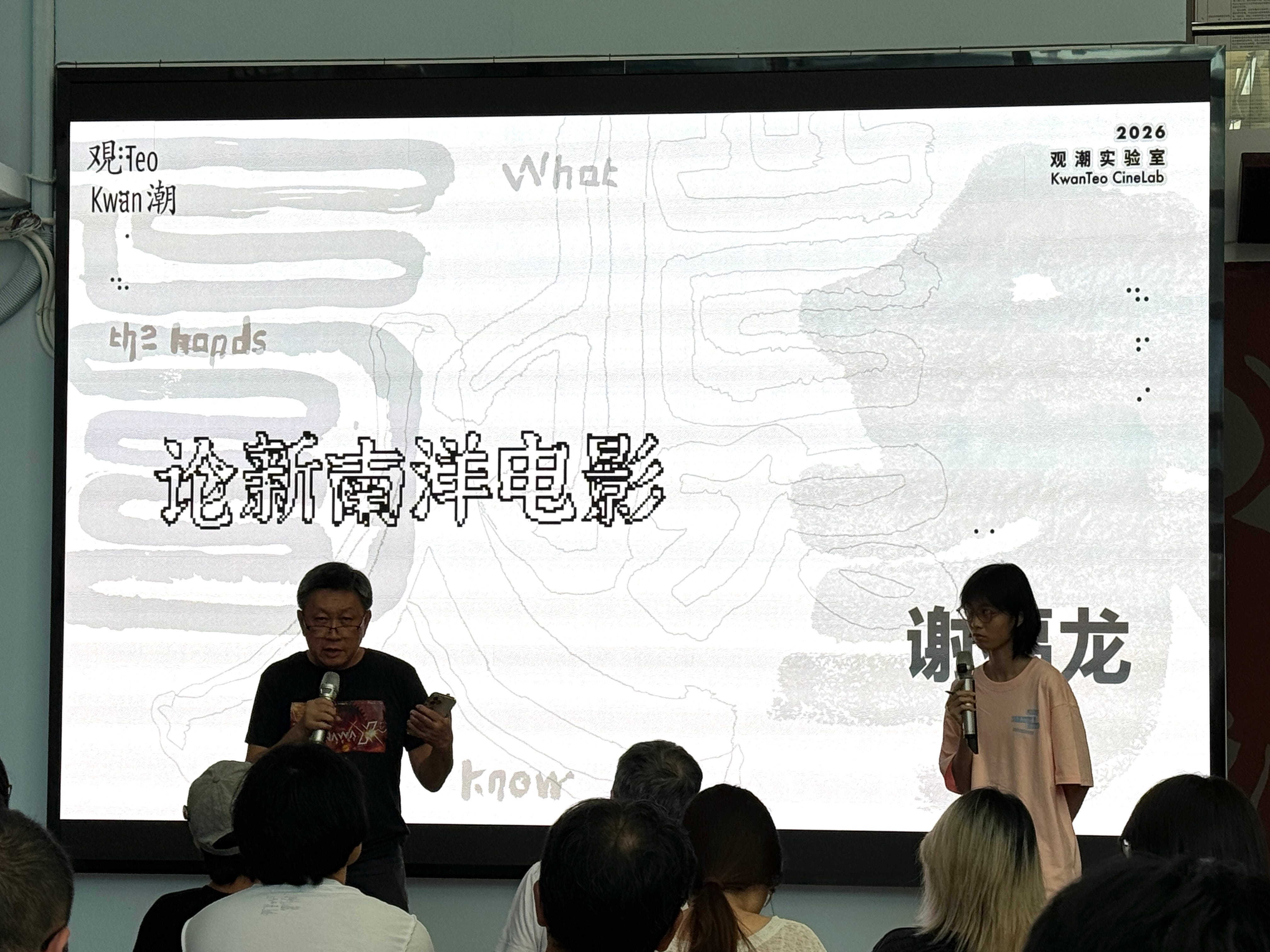
Senior film programmer Philip Cheah (Jogja-NETPAC Asian Film Festival, Shanghai International Film Festival, formerly Singapore International Film Festival) expands on Law Kar’s lecture at KwanTeo by de-centering Hong Kong as the site of Southeast Asian filmmaking hub and examining developments in today’s Southeast Asian market. At his KwanTeo Lecture, Cheah proposes the existence of a ‘New Nanyang’ Cinema.
Nanyang is transliterated as Southern Seas, referring commonly to Southeast Asia.
For Cheah, Old Nanyang refers to the 19th century Chinese diaspora in Southeast Asia who witnessed the colonisation and exploitation of the West. Cheah therefore defines the New Nanyang as the generation that followed after the baby boomers from 1946 to 1964 in post-colonial, independent Southeast Asia. Cultural freedom defined this generation, where rock-and-roll and pop culture influenced true personal independence and expression.
This generation also regarded themselves less as Chinese and through new myriad identities from non-Chinese influences instead.
Simultaneously, New Nanyang saw the fusion of cultures, particularly through assimilation and marriages with non-Chinese locals of these territories. For example, the Perenakan people represented the fusion between Malay and Chinese cultures. Cheah argues that British colonisation resulted in the normalisation of English usage, and less reliance on Chinese.
Hence, the osmosis of cultures between Southern China and Southeast Asia characterises the cinema of New Nanyang. Cheah used the Chinese feature Common Paper (dir. Zhang Jiuwo, 2025) as an example: Chinese filmmakers who were inspired by Indonesian filmmakers like Garin Nugroho and even researched in Indonesia as part of their filmmaking process.
KwanTeo co-founder Chen Baiqi posits that like the waves of the Sea, the fusion between cultures in Nanyang expands on influence, understanding and cooperation beyond geographic borders and limitations.
Cheah points out that both Teoswa Sonata (dir. Lu Xiaohao, 2025) and Dear You (dir. Lan Hongchun, 2026) featured the same actor Wang Yantong. Cheah was inspired by this synergy and the work by the founders at KwanTeo to term this a Chaoshan New Wave. He drew comparison to Taiwan New Wave: The restless youth, urban/rural divide, and natural observational rhythms point to a new generation of Chaoshan filmmakers that KwanTeo continues to develop through their CineLab.
The New Nanyang generation is necessarily culturally diverse, with different Southern Chinese languages beyond Mandarin characterising their works. Cheah points out the Chinese Southeast Asian directors that characterised these works. For example, Ah Girl (dir. Ang Geck Geck, 2026) sees the fusion of Hokkien and Mandarin. Similarly, Malaysian director Chong Keat Aun (director of Snow in Midsummer, 2023) also researches different Chinese dialects.
Yet simultaneously, the New Nanyang directors could also be disentangled from Chinese influences. For Cheah, this is seen through Luka (dir. Tiong Guan Saw, Malaysia, 2026) in Malay and A Useful Ghost (dir. Ratchapoom Boonbunchachoke, Thailand, 2025), with its focus on Thai.
Such diversity of influences and concerns anchors Cheah’s view that a New Nanyang Cinema exists. When questioned by an audience member regarding the problematic terminology of ‘Nanyang’, Cheah jokes that Luckin Coffee has a ‘Modern Nanyang’ flavour in Singapore. It points to the normalisation of ‘Nanyang’ in parts of Southeast Asia.
Cheah previously spoke at KwanTeo in 2025. This year, his interpreter brings up a statement from 2025 that encapsulates Cheah’s fascination with New Nanyang, where re-examining our viewpoints on geography and historical connections provides new means of examining one’s identity. Yet, above all, allowing for re-definitions with each new wave of the Sea means new cinematic experiences:
“Having a map is having a voice.”
Written by Daryl Cheong, edited by Phyllis Chan