


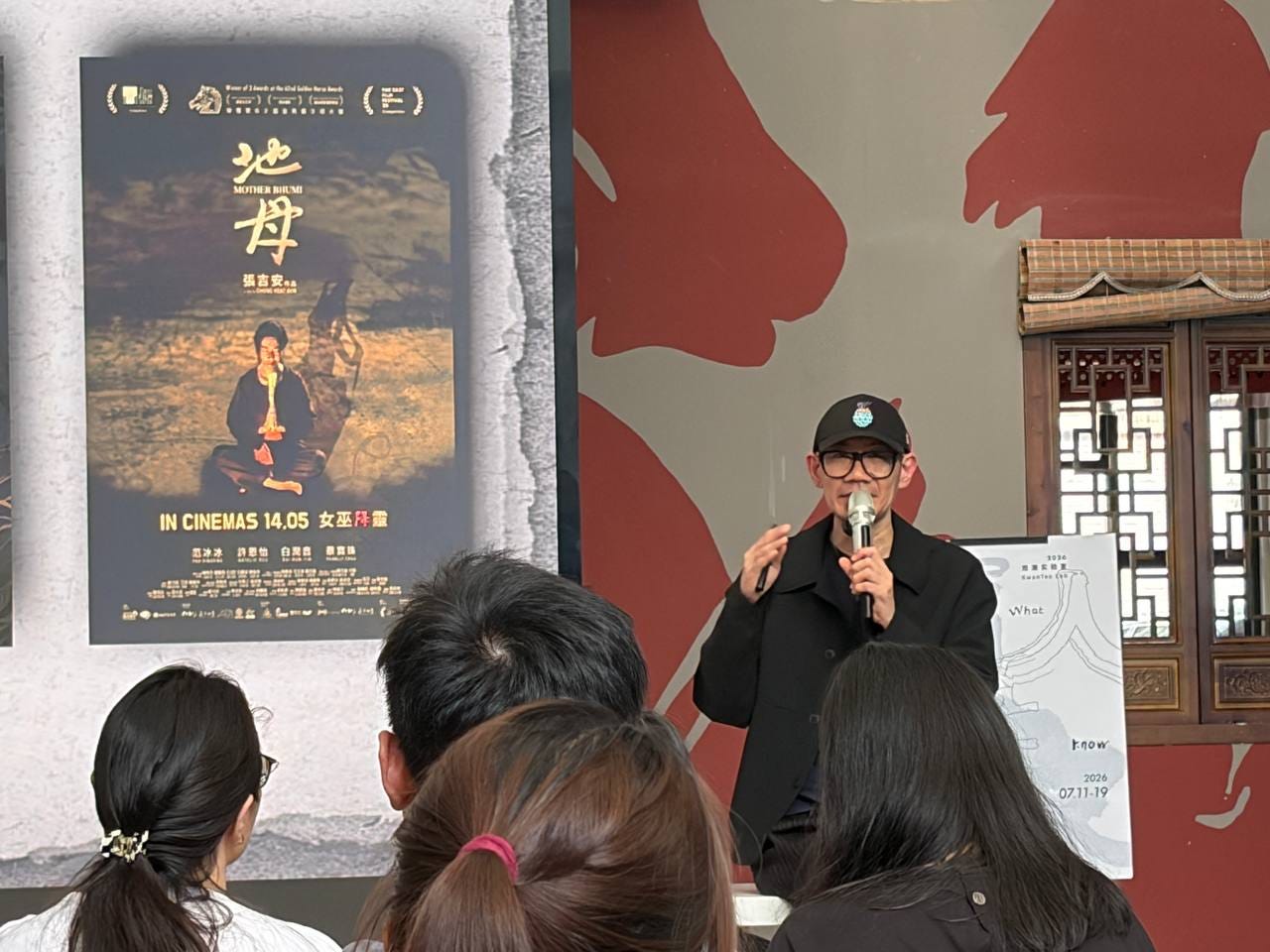
Unlike other sharings at KwanTeo’s Open Lectures, Malaysian Director Chong Keat Aun opted to speak about a deeply personal story: his search for his grandparents’ hometown in Kaiping County, Guangdong.
After graduating from university, Chong did not immediately pursue filmmaking. Instead, from 2000 to 2019, he embarked on a personal mission across the kampungs (villages) of Malaysia, recording folk songs preserved in the many ‘dialects’ brought by South Chinese sojourners. Guided by four principles — to collect, document, archive and exhibit — his work was driven by a personal desire to preserve voices that were on the verge of disappearing.
What began as a romantic impulse to document a generation before it was lost gradually evolved into a full-scale archival project. He eventually had the opportunity to expand his project into a late-night radio programme, The Classic Accents (鄉音考古), where Chong broadcast his archival recordings of folk songs sung in Teochew, Hokkien, Hakka, Hokchew and other Southern Chinese languages. The programme became especially beloved among elderly listeners, with many in their seventies and eighties inviting Chong into their homes so he could record their own voices, entrusting him with songs and their memories that had survived decades of migration.
During the lecture, Chong revisited these audio recordings and video excerpts from the archive. Funnily enough, the audience instinctively mirrored his own archival impulse, as they hurriedly reached out for their phones to record his archive. There were Hakka folks songs about watching husbands depart for Nanyang — a former term for Southeast Asia — and Teochew melodies recounting the hardships of coolie labour. As generations pass and these dialects gradually fade away from everyday life, the recordings preserve not only the songs themselves but also a linguistic world suspended in time. Many of these migrants had left Tangshan 唐山 — an old name that overseas Chinese once used to refer to Pre-Republic China, carrying with them dialects and expressions that would continue to evolve differently from those spoken in their homeland.
Among the most moving recordings was that of a ninety-year-old Teochew grandmother singing a folk song from a Teochew songbook. Chong shared that she passed away peacefully just two weeks after the recording. By bringing her voice back to Shantou at KwanTeo, allowing the song she had carried with her for decades to return to the place where she had first sung it, was a sentimental gesture by Chong to answer her longing for home.
Chong describes his work as a form of “spiritual care”, a philosophy that continues to shape his filmmaking. Speaking about Snow in Midsummer (2023), he traced the film’s origins to his discovery of a mass grave within the Sungai Buloh leprosarium compound in 2009. Besides graves that had been marked only with inscriptions such as “Unidentified Chinese”, those that could be identified often bore the names of their ancestral hometowns, reflecting the Nanyang Chinese tradition of inscribing one’s place of origin on their gravestones. For migrants who never had the chance to return home, these inscriptions became perhaps the final thread connecting them to the places they had left behind.
Chong chose to begin his lecture this way to highlight the care and historical necessity for filmmakers.
When discussing the censorship of Snow in Midsummer, Chong recalled that despite negotiations, Malaysian authorities demanded 27 cuts before the film could be screened. References to the May 13 Incident had to be removed, with an allusion to “the Incident” in the film’s dedication. However, rather than refusing the cuts outright, Chong accepted them so the film could still reach Malaysian audiences. At his evening post-screening conversation, Chong expressed his hope that this compromise would serve as the first step towards regulatory changes.
After its eight-week theatrical run in Malaysia, family members of victims of “the Incident” contacted Chong to ask where the depicted graves were located. For some, the film became the first step towards finding the burial sites of parents and relatives they had spent decades searching. True to Chong’s intentions, Snow in Midsummer was not just an act of remembrance of obscured histories, but had eventually become a medium of care that reunited families with those they had lost.
Reflecting on the film, Chong joked that he was fortunate to have made it only after he had matured. He believes that had he attempted to make it earlier, he would have approached it with anger and resentment. His experiences with the older generation and age, he said, had allowed him to make his films with nuanced compassion instead.
He recalled that his secondary school teacher had once described him as someone who does what seems out of step with the times. Prophetically, the teacher had argued that figures like this are always necessary. That offhand remark has come to define Chong and his continued insistence to preserve the voices and memories that would have otherwise been forgotten through what he believes to be the power of cinema.
Written by Phyllis Chan, edited by Daryl Cheong