


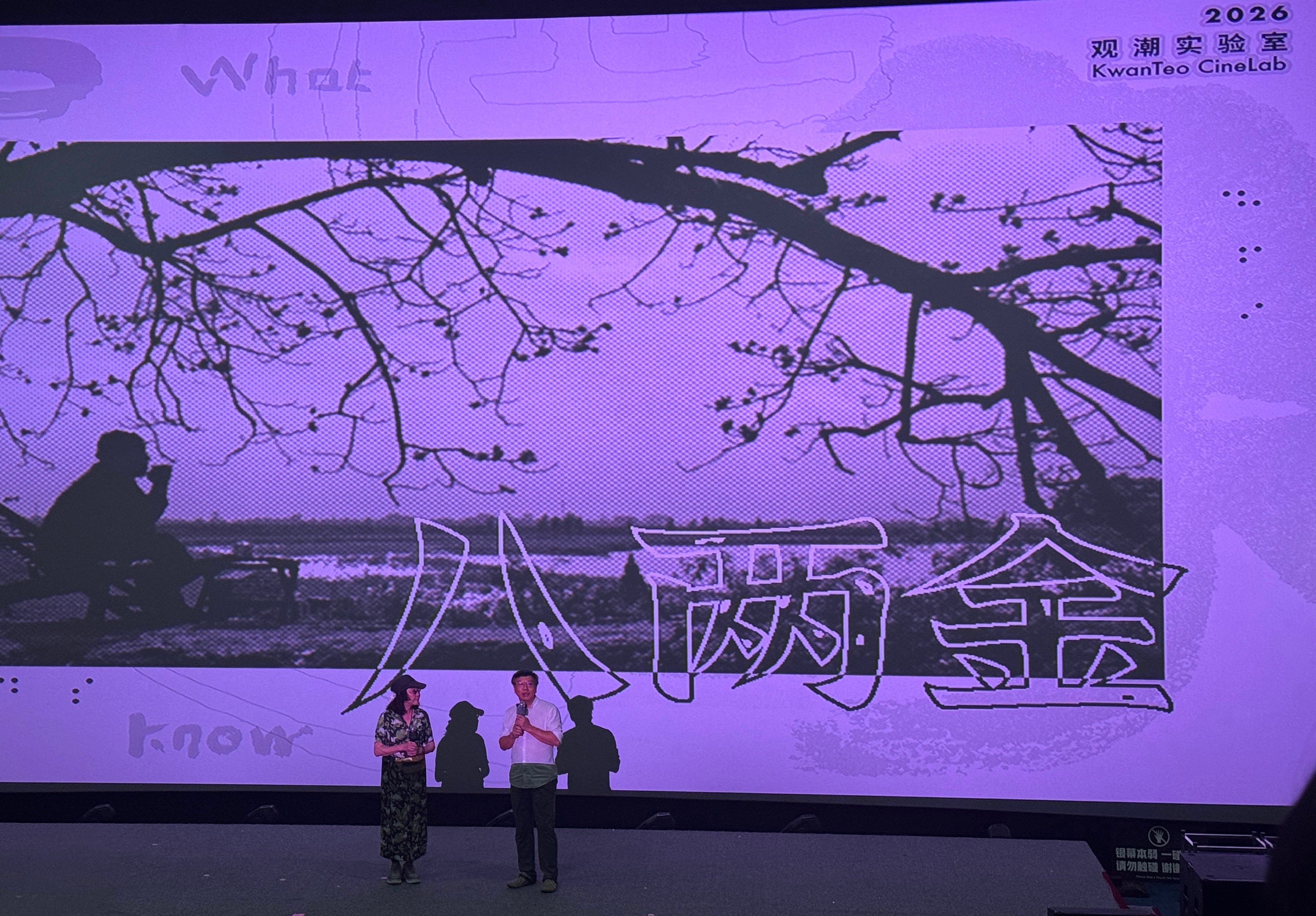
Teochew Cinema is receiving global attention of late, following the box-office records of Teochew-language Dear You (2026) across China and Southeast Asia. Speaking after a sharing of Eight Taels of Gold (1989) in Shantou on 12 July, the city where Dear You premiered, Mabel Cheung, one of three women directors part of the Hong Kong New Wave, affirmed her belief in the potential and “possibility” of Teochew cinema.
KwanTeo CineLab is an initiative presenting the works of Southern Chinese filmmakers and their diaspora. This year, the programme is centred around development workshops. That day, Cheung had paid a visit to Gezhou Village where she shot the 1989 film, conducted an afternoon open lecture, and conversed with an audience following her film in the evening. Naturally, programmer Feng Yu termed KwanTeo’s day of programming Mabel Cheung Day.
Conversations between KwanTeo and Cheung started more than a year ago. Although Cheung is not Teochew, Eight Taels of Gold was shot in and around Chaoshan, encapsulating key Chaoshan cities of Chaozhou, Shantou, and Jieyang. KwanTeo was therefore interested in the perspectives of an outsider and how cinematic traces of previous generations within Chaoshan can be revisited by a young audience, which Cheung terms as a privilege for her.
That film was also her first foray into shooting in Mainland China following two works set in the United States. When asked why by an audience, she shared that her Migration Trilogy needed to end there. The first two films explored experiences of migrants in New York City, and her final one naturally had to capture a migrant’s return to his homeland.
To her, the different protagonists of the three films could represent one person and their journey as a Chinese migrant in the States.
Feng remarked that Cheung’s position as an outsider naturally could present the film’s rural life with the sharp perspective she has. To Feng, her being an outsider is a strength. After all, the film made pointed political references to China’s One-Child Policy and the Cultural Revolution.
For lead actress, multi-talented Sylvia Chang, the film represented “nostalgia” and the search for a “sense of home”. She was curious about the traces of unfamiliarity, curiosity and resonance for a new audience. Chang, who was originally slated to attend a physical conversation with Cheung, had to cancel her plans due to personal reasons but shared these thoughts over a voice recording addressed to the audience.
Along this vein of nostalgia, Cheung agreed that cinema is a useful visual recording of a space, even when the spaces no longer exist. A sentimental audience member lamented the changes to Shantou’s landscape captured in the film, teary-eyed as she conversed with the director.
Even though she shot her film in Teochew-speaking parts of China, Cheung privately confessed to us that she does not watch much Teochew cinema. However, she remarks on Chaoshan’s picturesque landscapes, a point she made repeatedly during her sharing. She joked that the audience must be overly-familiar with the sights of the area.
She lamented jokingly, but with strange resonance to her earlier admiration shared about the migrant experience: “It takes being an outsider to see the beauty.”
Written by Daryl Cheong, edited by Phyllis Chan