


Unlike documentaries keen to insist on the filmmaker’s point, Taiwanese documentarian Wu Yao-tung’s films are distinctive by inviting you to spend time alongside his film’s subjects. Emblematic of the film’s title, I’m Here (2021) insists on the existence of its two subjects, whose best years as artists appear to have passed: Men Jixing and Wang Mo-lin.
Both of them were part of a theatre movement in 1980s Taiwan that was anti-government, experimental, and smaller-scaled. This was a response to the martial laws that lasted till 1987. This is part of Wu’s initial plans to explore the experiences of these 80s theatre groups that Wu had witnessed as an audience.
But time has moved on.
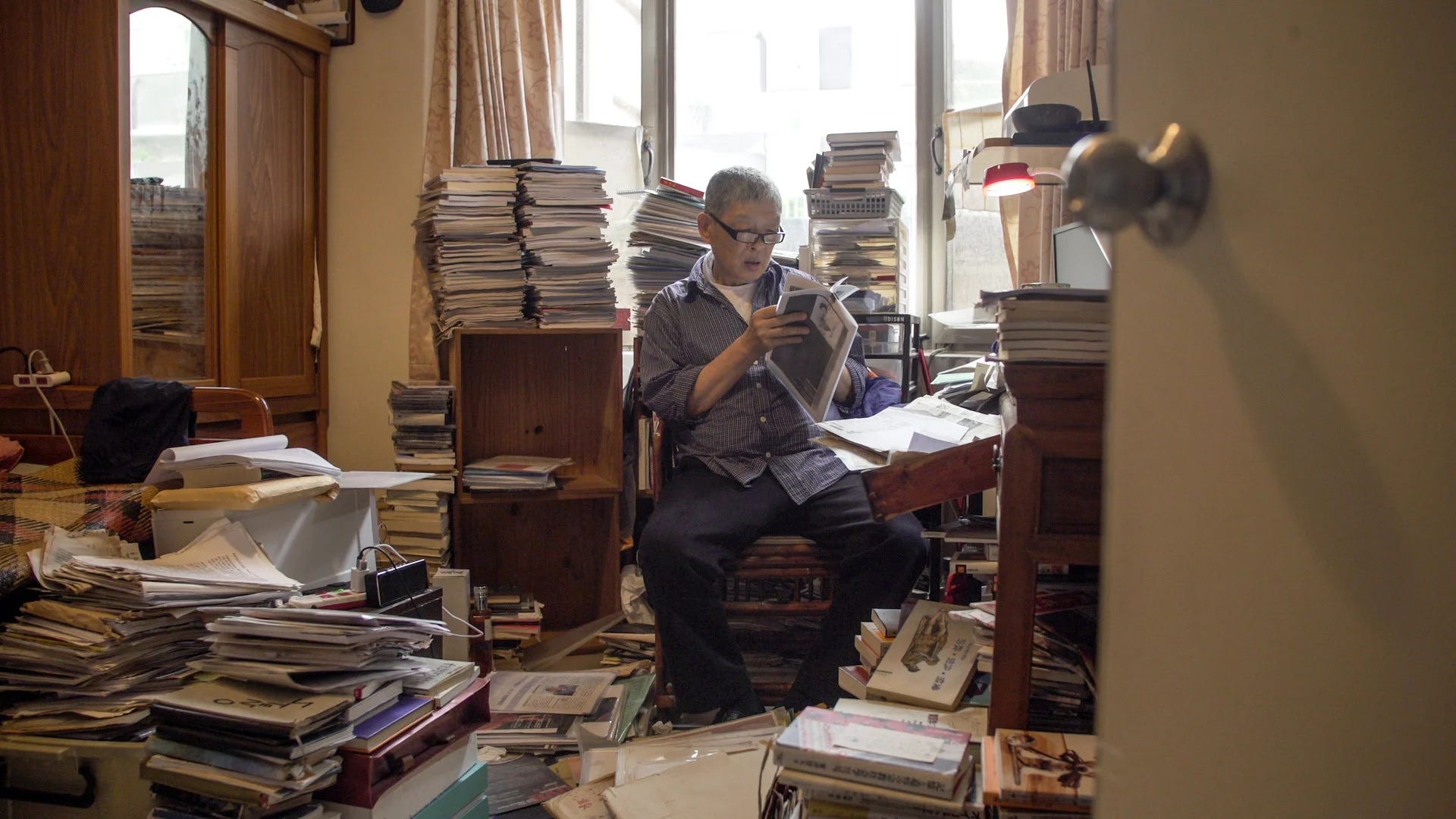
Jixing started the Little Theatre School to develop 20 students a year. Often slouched over, looking into the distance, and eating convenience store food, Jixing is visibly depressed. He laments the excitement of people coming together as a collective but eventually moving on to bigger plans.
In a brilliant structural choice, we hear about Jixing’s monumental performance in an adaptation of White Serpent before we see it. Through the staging, popular folktale turns into commentary, blending theatrical elements of camp, gender play, and non-conventional staging. Appearing in white briefs and Chinese Operatic make-up, the play reportedly drew huge laughter.
When we finally see footage of the play, we see a Jixing transformed: energetic, humorous, hopeful. The forty years have not been kind to him as he holds onto fragments of the past. Even more affecting is how Wu blends sounds of the play performed in the ‘80s with it performed by Jixing’s current students. In doing so, Wu creates a painful portrayal of Jixing as the ‘White Serpent’, struggling to survive in this world. Simultaneously, we experience time as Jixing: past and present blending into one, and all he has to hold onto is what he believes to be the path of a true artist, sacrificing himself for his art.
Spliced with Jixing’s journey is Mo-lin’s own. Much more senior, he used to write criticism and now writes children’s songs to make money. He absolutely loathes his current employment. Wu follows him around to trace the memories of significant performances of his past, but memory is not stable for Mo-lin.
Mo-lin spends his afternoons in a public garden. Wu questions the pointlessness of seniors walking around. Mo-lin pushes back. To him, the public garden has history. The garden’s past was social and exciting. For the seniors, it is them recreating and re-experiencing their memories. After all, they socialise, watch people, and exercise. True to his word, the ordinarily sharp and serious Mo-lin is seen dancing and bonding with strangers he had just met at the garden in a particularly humorous moment of the film. Wu removes the sound, taking the focus away from the music of the scene, and inviting us to simply be with these seniors.
Looking beyond the seeming pointlessness of the present, Mo-lin insists: “They have memories.”
In these moments, the film allows the two artists to speak to each other even if they never meet. Both are artists struggling in the present amidst a world that seems to have forgotten them.
This experience of the present is Wu’s greatest gift in his filmmaking. He does not rush. He allows the audience to spend time with the subjects, inviting us to go beyond observer and judgment to companion and empathy. At times, the film uses techniques of montage, voiceover narration, and sound effects to allow for Wu’s intimate commentary. However, these never feel condescending, but are ways of allowing Wu to express his feelings towards his subjects that are more personal and difficult to articulate in person. It also allows room for introspection, as the film continually grapples with the past and present.
The film is a special treat for all who flounder between time, and wonder if our best years have already passed.
Written by Daryl Cheong, edited by Phyllis Chan

