


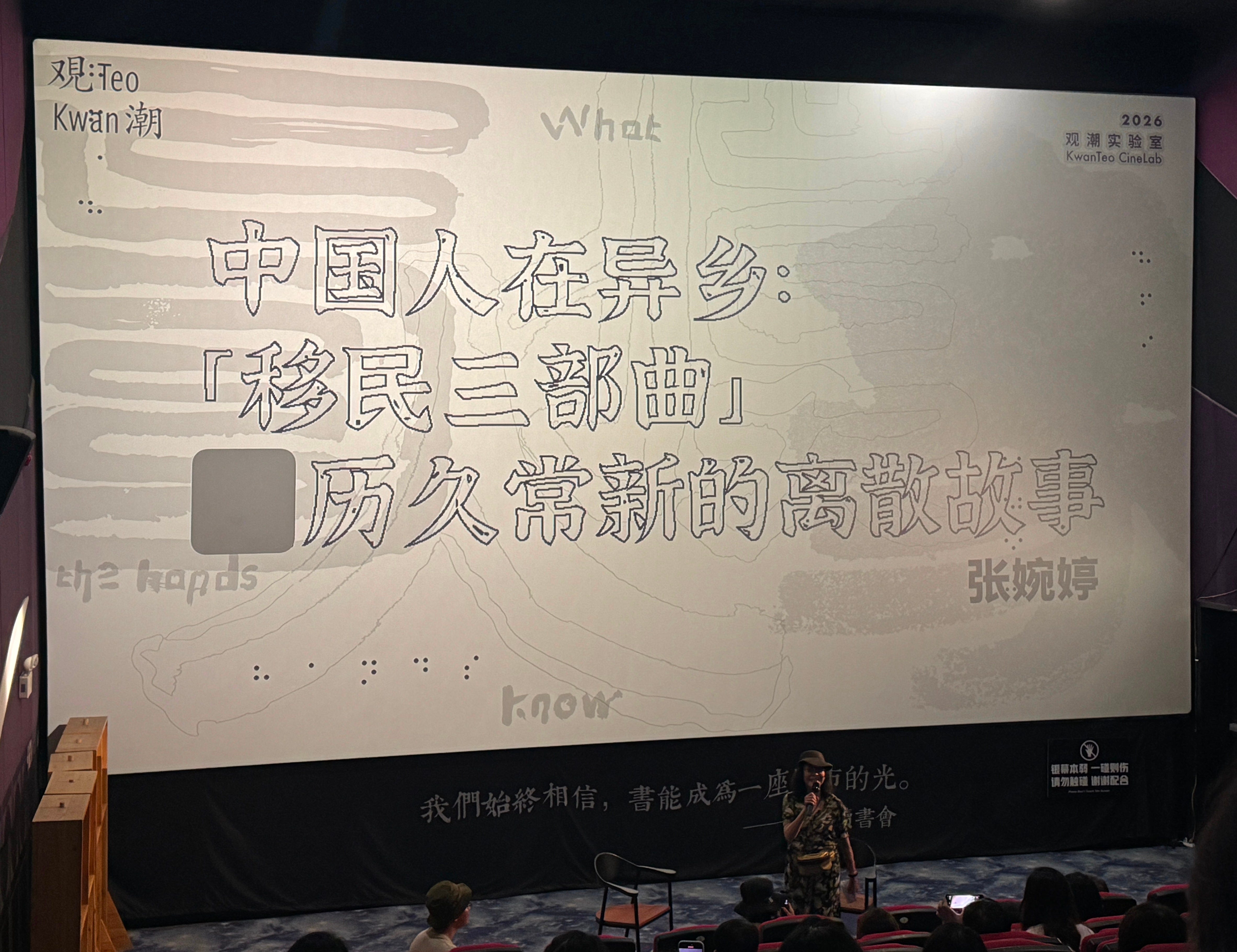
At her KwanTeo CineLab’s open lecture, Hong Kong New Wave director Mabel Cheung shares production experiences from her Migration Trilogy, reflecting on her experiences with America’s illegal migrants and society’s underbelly. These were further informed by Cheung’s own adventurous filmmaking methods.
Cheung encountered illegal migrants intimately in New York’s Chinatown whilst working at a VHS store to support her studies at New York University (NYU). Inspired by their harrowing experiences, she directed her first feature, The Illegal Immigrant (1985), as her third-year thesis alongside cast and crew who were her classmates. Continuing these concerns, her trilogy rounded up with two migrants’ contrasting lives in An Autumn’s Tale (1987) and the return of a Chinese migrant from the States in Eight Taels of Gold (1989).
Staying true to her communities, Cheung actively worked with non-professional actors. Gangsters played themselves and were surprised when the film’s success drew attention. Undocumented migrants played roles based on themselves. The lead of The Illegal Immigrant, Ching Yung-cho was a classmate of Cheung’s at NYU. Cheung humorously shared that Ching’s self-given name, Arthur Fulbright, was allegedly chosen in hopes of attaining the prestigious Fulbright Scholarship.
Before his big break in A Better Tomorrow (1986, dir. John Woo), Cheung cast Chow Yun-Fat as her next lead for his “romantic” looks. It was an unconventional choice as Chow’s earlier works struggled at the box office, according to her. Chow was, after all, transitioning from TVB work to movies. Cheung was spontaneous in her work with Chow. Without a budget for extras, Cheung placed Chow directly with non-professional New Yorkers when a scene placed him at Broadway’s rush queues. For An Autumn Tale’s final scene, Chow had to actually run into the streets of Manhattan, dodging taxis and vehicles.
Such spontaneity is symptomatic of Cheung’s methods, which saw her tie her cinematographer to the hood of a car to capture Cherie Chung’s final scene. For Eight Taels of Gold, Cheung’s Chaoshan crew took two days to plant trees native to the area that were not in season for a visual metaphor of seasonal change.
Reflecting on these unconventional methods often informed by budget constraints, Cheung quipped, “filmmakers are like this,” before quickly amending it to “I am like this” to rapturous laughter from the KwanTeo audience.
However, Cheung credits her success to such methods. Her thesis film became her first feature, even though graduation policies did not require it to be so. When financing that film, she took on Hong Kong producer Mona Fong’s offhand remark that she would invest in her work. Cheung flew back to Hong Kong for a meeting, calling herself “naive” but ultimately successful in her introductions.
Cheung recounted how Hong Kong gangsters had contacted their American associates to pressure Cheung’s production to recall Chow home for another shoot back in Hong Kong and would consequently heckle her for fewer takes whilst visiting her set for An Autumn’s Tale. Ever daring, Cheung would tell these gangsters to shut up. Yet, progressively, mesmerised by Chow’s performances, the gangsters quietened. In a rare, pensive moment at her lecture, Cheung quipped:
“That is the magic of cinema.”
Written by Daryl Cheong, edited by Phyllis Chan

