


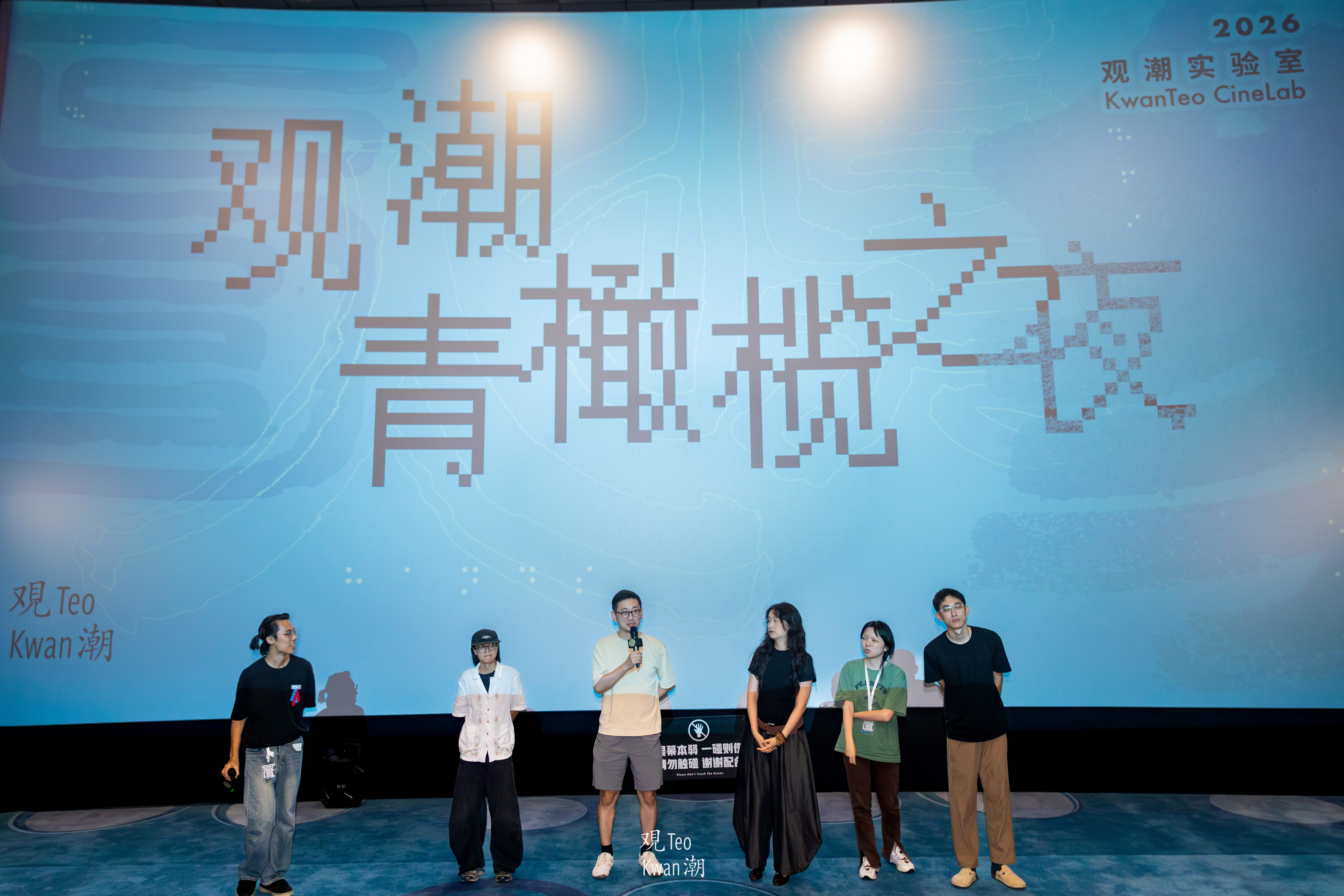
On 11 July 2026 (Saturday), KwanTeo CineLab opened with its flagship programme: the Green Olive Award. Since its inception in 2025, the programme recognises local youth filmmakers, and audiences vote for the prizes. The prize’s Chinese title 青橄榄 (qīng gǎnlǎn) uses wordplay to spotlight youths. Watching these works on screeners following the festival, their illuminating quality beckons an exciting future for Southern Chinese cinema.
Annie on the Dock (dir. Lin Yu-Pin)
The younger sister of a young deaf-mute fisherman has received her college admissions results. However, facing rising rent and uncertain futures, she rethinks her decision. With a simple story about family, the film evokes a socio-political reality of today’s youths who are caught in the malaise of financial difficulties. Its tenderness extends to the details of the small moments between siblings and minute details of everyday life.
Finding texture in the everyday, the film frames its characters within plastic sheets of a street vendor, degrading windowstills of floating fish farms, and curtains of a worn-down house. This composition provides aesthetic intrigue for the simple story, while simultaneously suggesting a search for clear communication marred by disparity in abilities and culture.
Nonetheless, the film obscures clarity in its final moments, creating ambiguity for a choice that would be more emotionally evocative with decisiveness. Furthermore, coming after films like Sound of Metal, its portrayal of deaf-muteness could have benefitted from more experimentation in not just its form but its focus. Precious minutes are spent watching a translation of a communicated dialogue. These minutes could have been used to enrich and deepen the storytelling. The film’s exemplary simplicity perhaps held it back from a more developed visual language.
Look Back (dir. Lin Qiying)
A standout from the section, this work unites the sensuality and emotions of Barry Jenkins with the poeticism and spirituality of Bi Gan. A young man looks back on the death of his father through narration of their final days together.
From the first words, “When we lived in the house,” the film compels you into its narrative. Beyond the 4:3 aspect ratio, Jenkins-inspired direct-to-camera close-ups for climactic moments, and lyrical narration, the film finds its poetry in the micro-expressions of its confident performers. They are at once believable and heart-wrenching. Its experiments with double exposure and anatomical shots of the body transform a simple premise and poetic form into brilliance.
In one dreamlike sequence, our protagonist wakes up to a flooded house. A recurring motif returns in the form of a cat at the finale, alluding to possible reincarnation. In lesser hands, these moments could have been cheap. Yet, through Lin’s rich confidence, these scenes feel at once earned and pained. Lin’s thoughtfulness heralds an exciting filmmaker to watch.
Elsewhere (dir. Lin Ting Xuan)
Keeping to themes of grief and death, our protagonist here wakes up from a dream–possibly of religious rituals. From the first intertitles, we are brought into the world of spirituality: Southern Fujian folklore believes that Gods move between mortals. Spurred by these recurring dreams, she travels to Thailand for answers.
Strange occurrences blend reality and dream: Speaking people suddenly fall asleep, worshippers at a temple are unconscious, and characters disappear from the film. These elements evoke the works of Apichatpong Weerasethekul, especially given the protagonist’s journey from the city into rural landscapes. No answers are given, or even needed. The atmosphere of escape into mysticism suffices. Curated in the middle of this packed programme, the film could easily lose its sense of awe that demands patience and journeying. Yet, the assured filmmaking of Elsewhere leaves one longing to stay within its beautiful dream.
Finding My Mama (dir. Wang Yinjie)
The only documentary in the programme, Wang’s film is a love letter to her deceased grandmother as the family sits down together to recount their fragmented memories of the matriarch. Stories of her sacrifices, tenacity, and migration piece together a journey only known through collective effort.
Wang’s form makes the film intriguing even for an outsider. Degraded news archives sets temporal context, old TV shows represent a person who can no longer be filmed, and books she read all become pieces recounted of her that, when put together, provide a possibility for understanding someone no longer able to be fully comprehended. Juxtaposed against the modernisation of China and the Cultural Revolution, Wang’s grandmother’s history becomes a lens into China’s own history. Xinhua (New Chinese) hairstyling becomes her trade amidst efforts to build capital, rendering her a symbol of New China. Aided by the aforementioned metatextual materials, we glimpse into China’s transitional decades.
Cumulatively, the documentary format can allow only a glimpse towards understanding. The family looks at photo albums together, and the narrator no longer recalls whether a memory of her grandmother is accurate. Yet through these fragmented narratives, Wang creates a singular work as part of her Prismatic Forest 2025 School of Film Art piece, less about her grandmother or a view of Chinese history, and more about the unstable nature of memory and the potential of it in the act of archiving.
How to Make a Perfect Wedding Film (dir. Zhang Yang)
Perhaps the singular outstanding work from the programme, Zhang’s film is metatextual, experimental, comedic, and tugs at your heartstrings. Centred on two wedding videographers trying to capture the perfect video, they realise that their only voiceover of the bride’s mother has been ruined by careless audio input into the camera. They adventure through ridiculous extremes to recreate and discover the lost dialogue.
Set against this ludicrous premise and an opening declaration that the wedding is the ultimate representation of love and respect, the film transforms into a story of mother and bride: a child’s desire to disobey, a mother’s inability to let go, and all that is unsaid between parent and child. For an Asian audience familiar with the onscreen reticence and parents’ senseless disapproval, the catharsis of communicating a parent’s love is earned and powerful.
Aiding its strong emotional core, the film experiments with form: a science-fiction ending visually conveys marriage as a departure from the family home, versatile and playful frames create a comic-like feeling, and subtitles are transformed onscreen to mirror the videographers’ editing of footage. These metatextual innovations demonstrate the filmmakers’ care and love for cinema, creating tonal textures that entertain and touch, and suggest all that cannot be communicated. As a whole, this remarkable film shines as the programme’s pinnacle and encourages an audience to remain excited for what else Zhang has in store.
In its entirety, the programme’s diverse tones and interests encourage an audience to be comforted and eager for the possibilities of young filmmakers from the Southern Chinese region. Often, filmmaking resources and educational possibilities are concentrated in China’s North. As part of efforts like KwanTeo’s to democratise accessibility in the South, these five films are breaths of fresh air in the canon of independent Chinese cinema. As these filmmakers journey on with their films and next efforts, what is clear is that these are five talents the global industry should pay attention to.
Written by Daryl Cheong, edited by Phyllis Chan

