


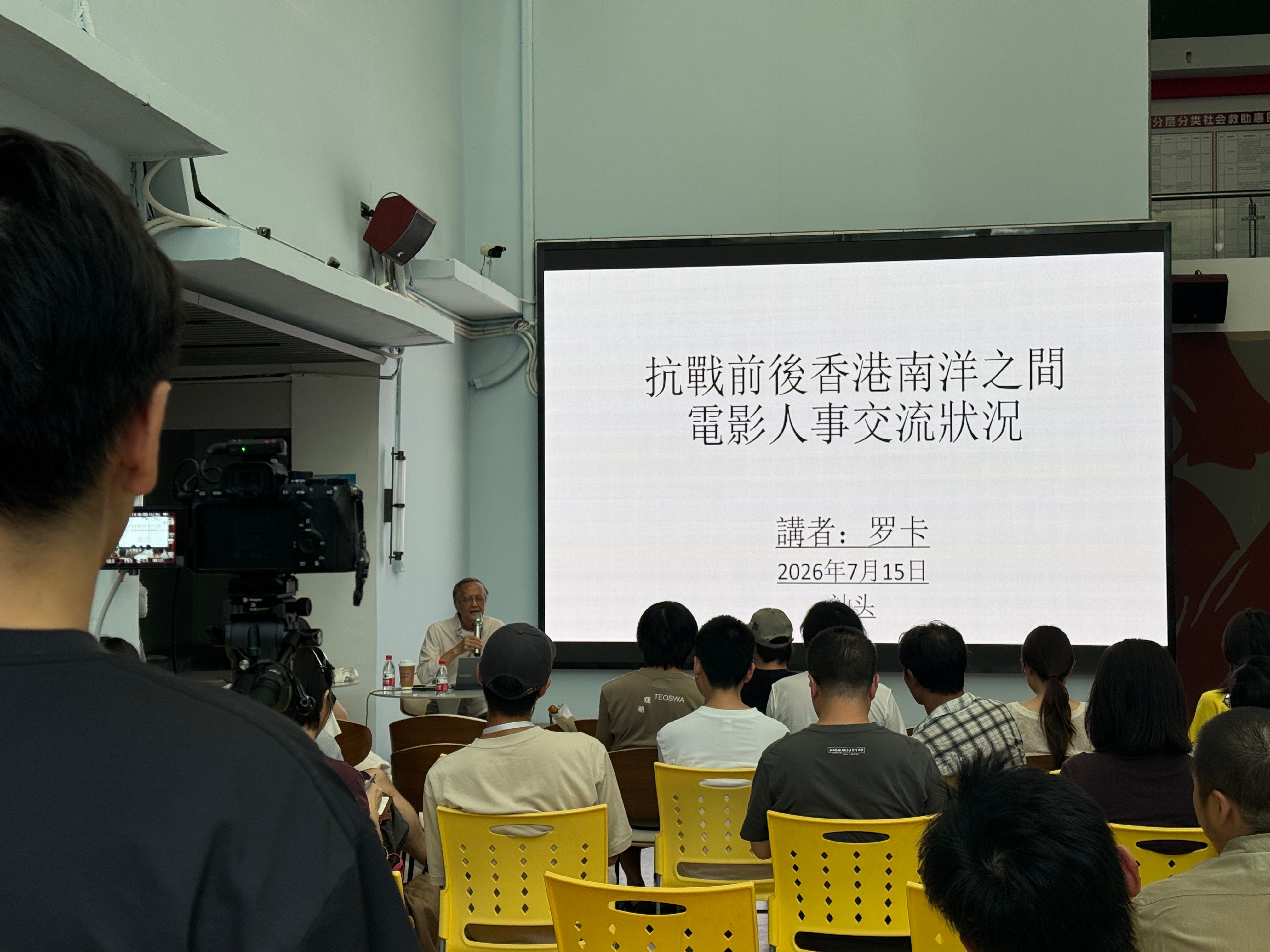
Senior Macau-born film critic Law Kar gave a guest lecture at KwanTeo, and argued that Southeast Asia accounted for Hong Kong’s pre-war film industry success and post-war revival.
Law demonstrated through statistics how Nanyang (the previous name of Southeast Asia) accounted for the largest share of pre-war film box office: Liangguang (Two Guangs referring to Guangdong and Guangxi) accounted for 22.5%, Hong Kong 12.5%, Macau 4%, the Americas 8.5%, Other Territories 12%, but Southeast Asia collectively took up 39.5%.
Largely across the territories, Law credits this success to the millions of Chinese diaspora migrating to the region for work. This was especially resonant in British-colonised Malaya and Singapore and independent Siam (Thailand), where then-King Rama VII loved Hong Kong cinema to the extent of collaborating with the industry on the 1933 film Romance in Mekong River (湄江情浪).
Law argued that some success was also seen in other colonised territories: Dutch-colonised Indonesia, American-colonised Philippines, and French-colonised Vietnam. However, he argued that Indonesia was hampered by infrastructure, with a lack of transport between villages and islands, and few theatres. Vietnam and the Philippines saw competition respectively from French and Hollywood films. Whereas Hong Kong cinema took longer, not consolidating its presence in these markets till the 1950s.
To Law, Hong Kong was always the transition point between economic and film powerhouse Shanghai and Nanyang. Especially in the early ‘30s, Shanghai performers dominated Hong Kong films but could not speak Cantonese and had to rely on dubbing. The Shaw Brothers, who built up the Malaya and Singaporean markets in the 1920s, also primarily showed Shanghai silent films until the mid-30s when Cantonese-language films in Hong Kong took up more attention.
Following World War 2, Chinese-speaking cinema was dominated by Communist China’s productions that utilised Hong Kong as a port towards Southeast Asian markets. During the war, resistance films against the Japanese invasion were also produced in Hong Kong before being distributed to the region.
Wuxia and romance films then dominated post-1947 Hong Kong production, following tedium towards resistance and war films. Between 1947 and 1949, more than 400 films were finished in Hong Kong, of which more than 350 were Cantonese ones. Most of these were exhibited in Southeast Asia, galvanising the revival of post-War Cantonese cinema.
Cinema fuelled by filmmakers in exile also contributed to the market revival. In 1952, the Union Film Enterprise (中联影业公司) emerged as a filmmakers’ cooperative. The filmmakers did not receive fees for their works. Rather, production began once deposits were received from distributors in Singapore and Malaya, and they were paid accordingly by recouping box office gains.
KwanTeo Programmer Feng Yu concluded that Mainland Chinese knowledge of Chinese-language cinema tends to be restricted to the geographic boundaries of China, but Law’s lecture provides an accessible understanding of Southeast Asian markets and their importance in developing our knowledge of Chinese cinema.
KwanTeo began cultural exchange and collaborations with Southeast Asia in 2017, being one of the first film events with a focus on the Southern Seas.
Written by Daryl Cheong, edited by Phyllis Chan

