

A 2K restoration of the Chinese cinematic classic Crows and Sparrows from 2024 was screened at KwanTeo. Set in a single house and its ensemble of tenants and landlords, the film forms a perfect allegory of China that reflects the ideological shifts towards the end of the Chinese Civil War.
Kuomintang governed Mainland China from 1928 until it was threatened by the Chinese Communist Party. The landlord Hou (monkey), naturally, is a Kuomintang military official. His opulent wife desires to profit from their house and therefore decides to evict its three families of tenants. A juxtaposition of class and status is created, where crows represent the greed of the Kuomintang, and the sparrows reflect the innocence and goodness of the proletariat.
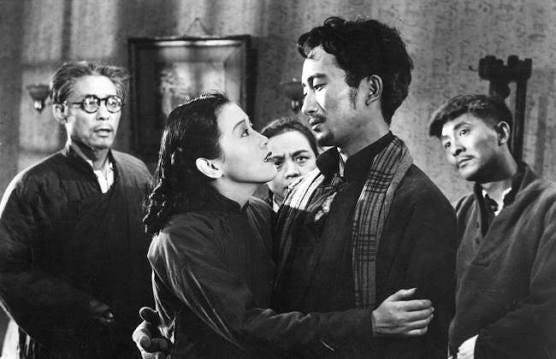
The ideologies are thinly veiled for contemporary standards. Each family is tempted by greed, desire and indifference to compel them towards inaction when faced with eviction. Eventually, threatened by material lacks or dramatic shifts, they unite to reclaim the house (and by extension, China) from Hou in a symbolic climax set by the staircase, where high and low angles, shifting of levels, and camera zooms signify the shifting of status as Hou falls from power and the people rise up.
In spite of its ideological superficiality, the film is a useful resource, providing insight into the changing sociopolitical atmosphere around the end of the Civil War. Half of the film was produced before the end of the War, with the other half of production concluding after. For the filmmakers, they reflected the ideological shifts as “natural” and therefore sought to use cinema to articulate the desires of the common people. Hence, while the film may be uninspiring today, it was a landmark in representing the call and desire for collective action and revolution.
Particularly symbolic is the change in the picture framed on the highest floor. As a symbol of power and status, the highest room is reserved for the landlord. By the denouement, the image of Officer Hou is replaced by that of old man Kong and his deceased son. The son was shamed for being a Communist, a vulnerability that Hou repeatedly exploits against Kong. Kong, an intellectual working as a copywriter, struggles alone. Of note is how Kong’s surname alludes to his lineage as a descendant of Confucius, thereby ascribing him with wisdom and historical status. By extension, the Communist movement is likewise positioned as the inheritor of this intellectual and historical legacy. The replacement of the picture is a literal shift in framing: from Kuomintang exploitation to Communist ideals, from animalism to wisdom, and from individuality to collectivity.
The film relies on cinematic language reminiscent of the Classical Age of Hollywood, providing regality and importance to a film challengingly set mostly in a single location. Deep focus creates a richer sense of depth, and diopter lenses evoke two planes on a single one. The film was also anchored on famous actor Zhao Dan’s performance, whose films like Street Angel (1937) and Crossroads (1937) established him as a celebrated actor by 1937, before he was imprisoned by a Kuomintang warlord.
For a simple narrative elevated to historical significance through its context, production history, and ideological representations, Crows and Sparrows would continue to prove significant, especially presently amidst its 2K restoration.
Written by Daryl Cheong, edited by Phyllis Chan