


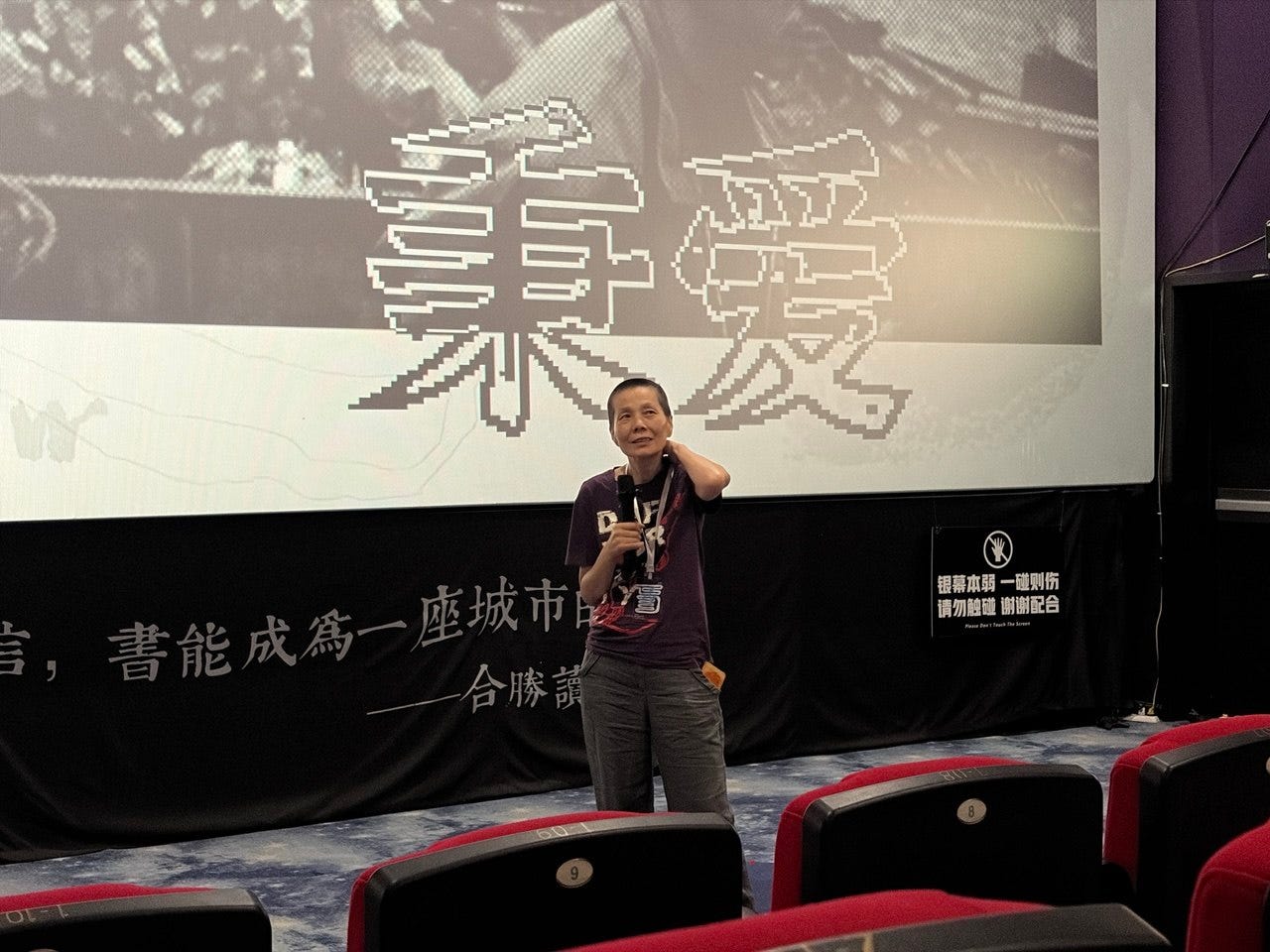
Chinese documentary filmmaker Feng Yan is not your typical director. Sporting a buzz cut and speaking into the microphone with an almost improvisational energy and without the prepared slides expected from previous guest lecturers at KwanTeo, she immediately exudes an air of disarming informality. It feels fitting, then, that her path into filmmaking was just as unconventional.
She did not come from film school. Feng studied Japanese literature in university before moving to Kyoto to pursue agricultural economics. She recalled having “no concept of documentaries or photography” and that her introduction to both came unexpectedly in 1992, when she worked as a translator for a photography exhibition. Encountering documentary photography and photojournalism for the first time, she realised that these mediums were a means of understanding the world, something she felt was largely denied from her while growing up in China.
When DV cameras became increasingly accessible in 1992, Feng picked one up for the first time. She did not do so with the aspiration of being a “filmmaker”, but rather a desire to better understand her own country and the world around her.
With plans for the Three Gorges Dam set to transform the Yangtze River, her curiosity eventually brought her to the Three Gorges region in 1994, where she became acquainted with a peasant woman, Zhang Bing’ai, who would later become the subject of her 2007 documentary. Reflecting on their first encounters, Feng remembered that while everyone else addressed her as “Reporter Feng”, Bing’ai simply called her by her name. Rather than treating Feng as an authority figure, Bing’ai approached her as an equal. Looking back, Feng believes Bing’ai simply wanted someone she could confide in. In a tightly knit rural community, where everyone knew each other and societal expectations often demanded that people save face, an outsider sometimes became the safest person to entrust one’s worries.
The relationship that developed between them extended far beyond that of filmmaker and subject. When Feng first screened Bing’ai for her in Beijing, Bing’ai tearfully exclaimed that she and her husband “looked like actors”, before joking that she “should have been more cooperative” during filming. As the audience erupted in laughter, Feng recalled the memory with an equally warm smile.
When asked what had become of Bing’ai after the documentary’s release, Feng happily shared that she was doing well. The film had brought visitors from across China and around the world to the Three Gorges region, many of whom made the journey simply to meet her. Bing’ai now welcomes these visitors into her home, cooking meals for them and spending hours in conversation. Feng herself even became an unlikely middlewoman for Bing’ai’s tangerine harvest, helping to sell them online as Bing’ai shipped the fruits to people across China.
For Feng, the documentary was a way of connecting Bing’ai with people far beyond the Three Gorges. It is perhaps unsurprising, then, that Feng said she only makes films about people she genuinely likes and respects. She has no interest in pursuing stories that require her to force conversations or make herself uncomfortable simply to obtain more footage. Over the years, her relationship with Bing’ai has evolved from that of director and subject into a lasting friendship.
Smiling, Feng simply described it as “destiny.”
Written by Phyllis Chan, edited by Daryl Cheong