

With the theme “Second Life, Second Skin”, Singapore Panorama Shorts Programme 2 explores moments of major upheaval and the possibility of being undone and remade across five short films. While some tangle with the growing pains of coming of age, others engage with the turmoil that comes with (re)engaging with trauma.
The programme opens with Shara Tay’s Kiss Me Climax, an animated short film which details a young girl’s unexpected sexual awakening after the latest chapter of her favourite manga leaves her seeking further gratification. Surreal and highly expressive, Tay employs a mixed-media approach to help bring to life the crazed daydream of an impassioned teen, utilising a wide array of textures and environments to convey the intricacies in that moment of lust.
What follows is a tale as old as time in Ash Goh Hua’s Subterranea, as a teenage girl struggles with the deep well of emotion within her. With her body becoming more alien to herself, she lashes out in increasingly erratic ways. Goh’s film is most effective in localising the experience of coming of age and the alienation that can spring forth from the maelstrom of emotions felt within oneself. The choice to materialise the subterranean feelings of the protagonist into a shocking physical transformation is a nice touch and an excellent use of magical realism.
Things go from weird to surreal in Syahmi Iman’s REANIMATOR, where a filmmaker tries to confront his fear of bugs through the process of taxidermying a bee. Iman’s mixed-media approach, blending digital film formats with analogue layers, stop-motion animation and physical taxidermy, really lends the film a distinct textural quality that feels decidedly punk-rock. A childhood fear is transformed into an object of fascination through the process of artistic reinvention.
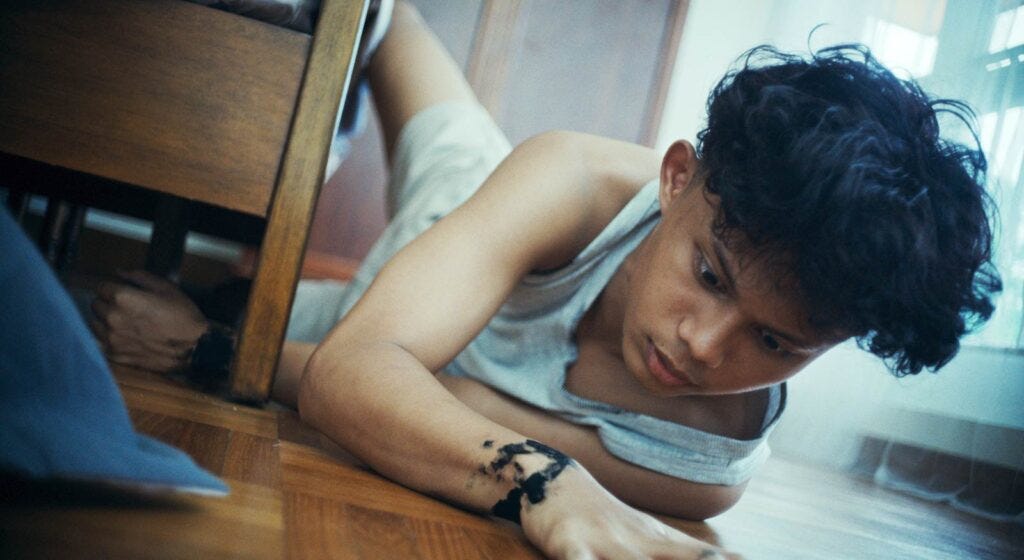
Following Iman’s REANIMATOR is Leon Cheo’s Orang Minyak. Rayyan, a teenage boy, finds himself haunted by a mysterious entity after waking up with oil stains on his body. The filmmaker’s latest film functions as both a haunted house horror and a harrowing family drama. Cheo smartly taps into regional folklore and supernatural tales to add a mythic dimension to his film, with the Orang Minyak serving as the physical embodiment of queer repression and a perpetrator of sexual violence that perpetuates intergenerational trauma.
To bookend the programme is Ewan Leong’s Encik, which follows an army warrant officer, colloquially known as encik, as he grapples with the aftermath of a young serviceman’s death and the days of introspection that follow. Leong’s film maps the ways in which grief takes shape, and how these moments of major upheaval can even force us to confront our ideals and the systems in which we exist or propagate. Perhaps what’s most effective in Leong’s work is its ability to capture a sense of tension, of things bubbling just beneath the surface; the eerie quiet right before a storm.
These films utilised a variety of genres to depict the aftermath of change, offering a glimpse into the many possibilities of what it means to come undone and put oneself back together again. The subject of change and renewal is hardly an inventive one, but it is undoubtedly universal. In this programme, we perhaps get a glimpse into the contemporaneous mood of our nation.
Written by Adrian Ho, edited by Phyllis Chan