

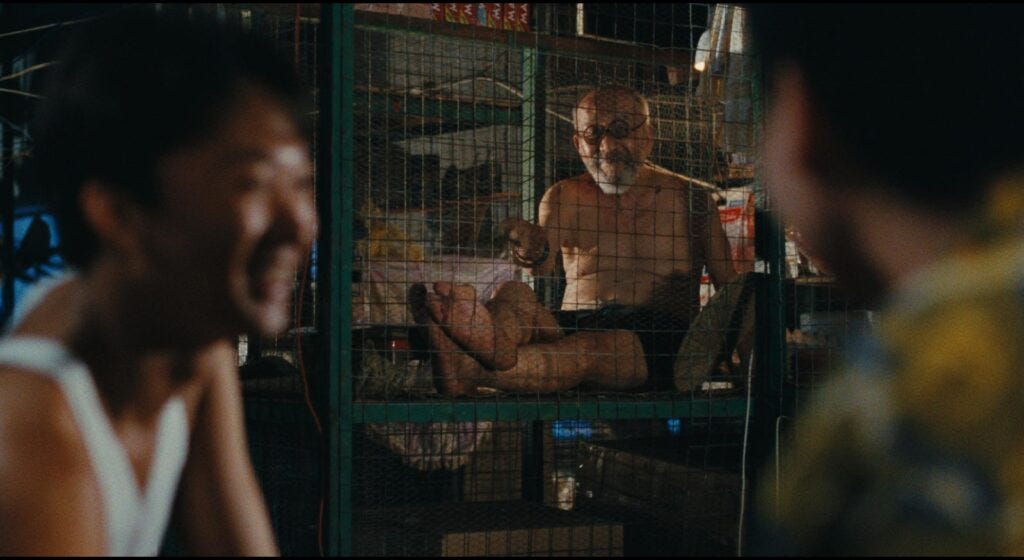
For the unacquainted, Jacob Cheung’s award-winning film about the everyday realities of residents living in chicken-wire cages stacked together in a worn-down men’s hostel may seem like a momentary lapse into dystopia or a far-flung memory of a hushed time. However, in reality, Cageman (1992) depicts the struggle of the elderly and those in Hong Kong with lower incomes. While the poorest residents of Hong Kong today may no longer stay in literal cages, many still live in substandard and cramped units – in subdivided flats, “coffin homes” and bedspace apartments.
Audiences today perhaps remember the Hong Kong cinema of the ‘90s as the commercially viable kung-fu and virtuosic action films. I wonder how many remember Cageman.
Since the film’s release in 1992, Hong Kong lawmakers have passed legislation to crack down on and phase out substandard tiny housing units, setting minimum sizing and safety standards for “basic housing units”. The Bedspace Apartment Ordinance policy that regulates safety standards was passed in 1994. While the issue is far from resolved, with both the housing crisis and the wealth disparity persisting, Cageman was integral in spotlighting the horrific living conditions of the city’s poorest residents. Its reach was even affirmed by honours like Best Film, Director and Screenplay at the 12th Hong Kong Film Awards.
Cageman operates in the tradition of Allen Fong and Ann Hui, à la the realm of social realism and humanist dramas. Cheung’s film is particularly successful in combining his gritty social commentary with an absorbing character study, bolstered by a strong ensemble cast that breathes life into the oft claustrophobic close-quarters of the men’s hostel. There is a sense of community and camaraderie intimately present in this rag-tag bunch akin to a misfit family unit. While the film is episodic in nature and set in impossibly tight places, Cageman never feels restricted by its physical limits. Rather, with Andy Lam’s cinematography and Cheung’s blocking, like a marvel of a stage play. Cheung directs with a light touch, and the film, while always committed to the harsh realities of its residents, never feels like an exercise in sympathy.
Instead, we are invited into the intimate world of the residents of the Wah-Ha cage house and given an opportunity to partake in the camaraderie. There is a beautifully melancholic moment near the end of the film when the residents break into song and dance — a final hurrah before morning breaks and reality will force these bedfellows apart. Cheung’s commitment to social realism rips away the eventual fairytale ending that we may have desired for the residents of Wah-Ha, but here, within the final moments of the film, it seems that even a realist like Cheung tries to manifest a reversal of fortunes for his ensemble of misfits. The poor live on, in one way or another.
Written by Adrian Ho, edited by Daryl Cheong