

Watching a Hong Sang-soo film reminds me of watching a still life painting. On the surface, it seems as if nothing is happening. Yet, in the details hidden in plain sight, a potential story emerges. With Hong’s latest Locarno-premiering work Nowhere to Lay My Eyes (2026), Hong returns to the family unit as a site of exploration, glimpsing into moments of resentment and frustration under the veneer of politeness and ‘love’.
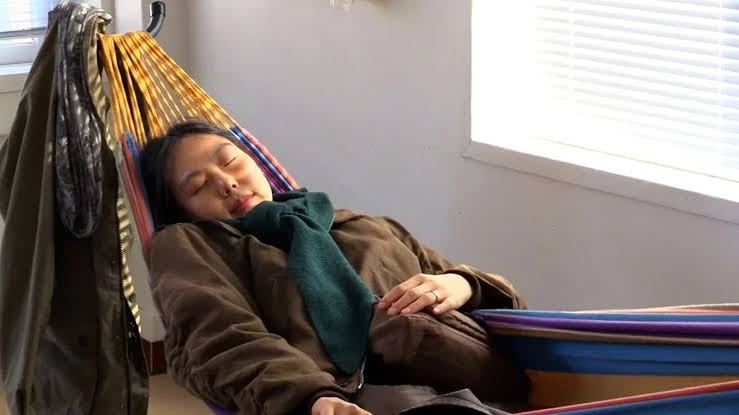
Hong’s muse Kim Min-hee plays Sanghee, a filmmaker who returns to her hometown of Jeju Island from Seoul with her brother to visit their mother after a decade. Her mother has moved on with a new husband, whose daughter recently began exploring painting. As with most stories depicting families from Asia, secrets and new information unravel. Yet, unlike other works, Hong’s film is uninterested in emotional fallout. After all, in societies that weaponise backhanded remarks to obstruct criticism, real life is not always dramatic. Hong also introduces Sanghee’s narration that often directly contradicts what she had articulated in conversations right before. In drawing attention to the dialogue’s subtexts and truths, Hong invites reconsiderations of what else is said (and therefore unsaid): compliments from the new step-sister about Sanghee’s films.
Yet, perhaps most remarkably, Hong injects contemporary references of today. Unlike his earlier body of work, which rarely contemporarises the narrative, Hong acknowledges newer technologies of YouTube, and even considers the impact of artificial intelligence (AI) with a character’s off-hand remark that AI could never replace caregiving. Remarkably, one of Hong’s usual dinner conversations draws a comparison between documentary filmmaking and Israeli-Palestinian relations––Sanghee argues that documentaries from both Israel and Palestine argue for their own truths, and lack a larger objective Truth, rendering the medium an act of “brainwashing”. Whilst one could argue that these could be incidental, the recurrence is startling for Hong’s work.
Simultaneously, the references to death could invite considerations into Hong’s untimely look at modern concerns. Stepdad-documentarian is making a film about grass graves, and the stepsister reconsiders the impossibility of eternity after watching Sanghee’s films. Taken together, both lead me to wonder if Hong is taking new considerations towards his legacy.
The film’s ending is perhaps one of the gentlest and kindest of Hong’s, in an understated and almost unremarkable way. The family watches Sanghee’s experimental film when she cannot be found on the day of her departure. In it, she shares that as a child, she would often look at weeds and small flowers. These spoke to her, especially in moments of anxiety. Tasked to find Sanghee after a morning of failed attempts, the brother miraculously discovers her studying wildflowers. The minute he finds her, the film ends. It is as though, for once, in a film (and perhaps a life) marked by the careful interpretation of words and uncertainty over others’ intentions, Sanghee is finally seen. There is a certain romance to this ending, one that we want to believe in.
Hong stays at his prime form, and we are all the better for it.
Written by Daryl Cheong, edited by Phyllis Chan