

Exile (2020), directed by Visar Morina, is a layered and sophisticated character study that dissects the xenophobic gaze cast upon the immigrants. Exile offers a different perspective on the immigrant experience from Morina’s debut feature, Babai (Father, 2015), which won the Best Director Award at the 50th Karlovy Vary International Film Festival.
Babai follows a teenager’s journey as he flees from Kosovo to Germany to look for his father, while Exile unveils the alienation experienced by an immigrant. Where Babai looks at the act of crossing the border, Exile exemplifies what comes after.
Exile’s psychological drama unfolds the mental state of Xhafer (Mišel Matičević), a victim of xenophobia who moved from Kosovo to the suburbs of Germany. The film opens with a dead rat strung in front of Xhafer’s house, triggering his musophobia. He suspects his colleagues of the disturbance, reminded of the many dead rats he has encountered at the chemical engineering company where he works. The antagonism is rooted in him replacing a former colleague. As Xhafer hunts down the perpetrator, he grows increasingly paranoid.
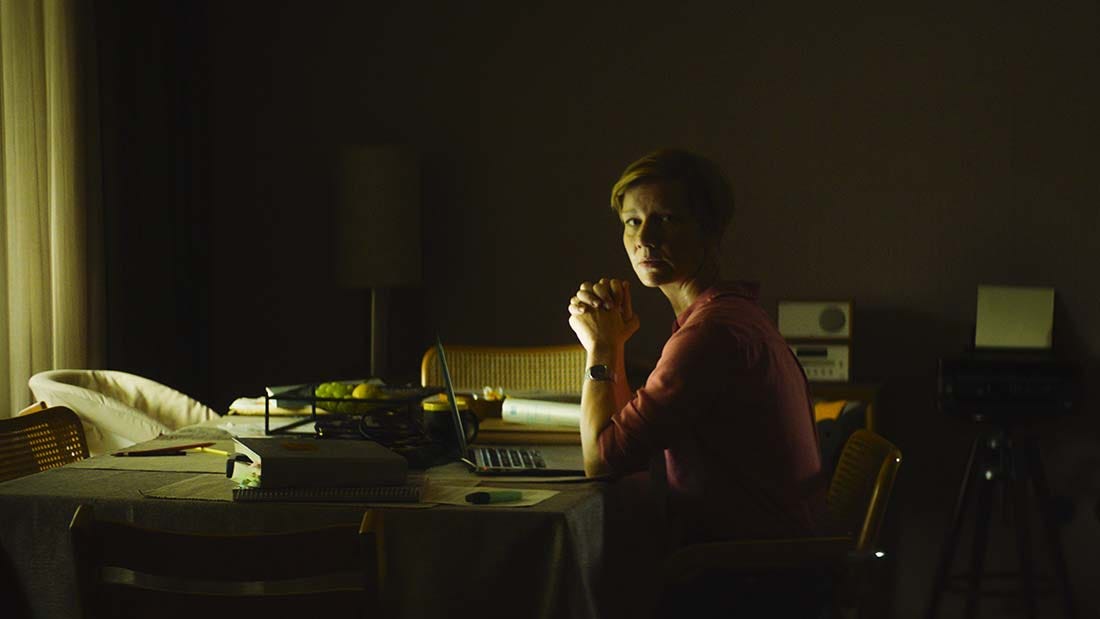
Xhafer’s sense of alienation is caused by the hostility of his colleagues: he is excluded from the internal emails and important meetings, mocked during the meetings because of his Kosovan identity, and looked down upon by his mother-in-law. The cornering of Xhafer is also mirrored in the claustrophobic cinematography.
Beyond the external pressures, Morina reveals one’s mental state from the invisible and ineffable discrimination faced by new immigrants assimilating into a new environment through a focus on Xhafer’s internal state. The film is concerned with immersing the audience into the breathlessly suffocating experience of an everyday immigrant.
Beyond these societal and internal pressures, Xhafer continues to struggle at home too. Even with a German wife (Sandra Hüller) and three children, he struggles at home. It is almost as if alienation is unavoidable in the process of assimilating into a new society.
However, at the climax of the film, Xhafer’s accusation of an alleged perpetrator is met with a severe consequence. This Dostoevsky-esque development reflects on the parallels between Xhafer and a German, which might have diverted from the xenophobic commentary. However, this actually strengthens the film’s commentary: the simultaneously double-edged violence vis-a-vis the immigrant.
One must not overlook the performance of Mišel Matičević. Mišel’s subtle yet powerful performance punctuates an immigrant’s alienation and the pains of integration through a stoic silence accumulated from internal age and the abstruseness he experiences. Through him, the film channels its emotions and message powerfully.
Overall, the Kafkaesque depiction of the character’s mental journey adds a surrealistic touch to the film, but the issues encountered by the character remain realistic. After all, the film is deeply rooted in the director’s personal experience as a Kosovan immigrant moving to Germany as a teenager. Exile extracts elements of psychological thriller and touches of surrealism to integrate them meaningfully within the discussion on identity, alienation, and sense of belonging for a migrant particularly.
Exile will be screened on 11 October 2026 at Filmhouse as part of the German Film Festival.
Written by Lee Peng Ming, edited by Daryl Cheong