


Germany, 1949. A divided nation between East and West. A nation discovering its soul again.
The perfect conduit for a soul-searching journey is the trope of the road trip. Nobel Prize-winning German writer Thomas Mann (Hanns Zischler) has been based in the United States since 1933, evading Germany’s interwar disintegration. He goes on a road trip through Germany with his daughter Erika (Sandra Hüller). First, to Frankfurt, West Germany, to receive a Goethe prize whilst announcing that he will receive a second Goethe prize in Weimar, East Germany. Western journalists warn him that should he travel to the East, he may be barred from re-entry into America.
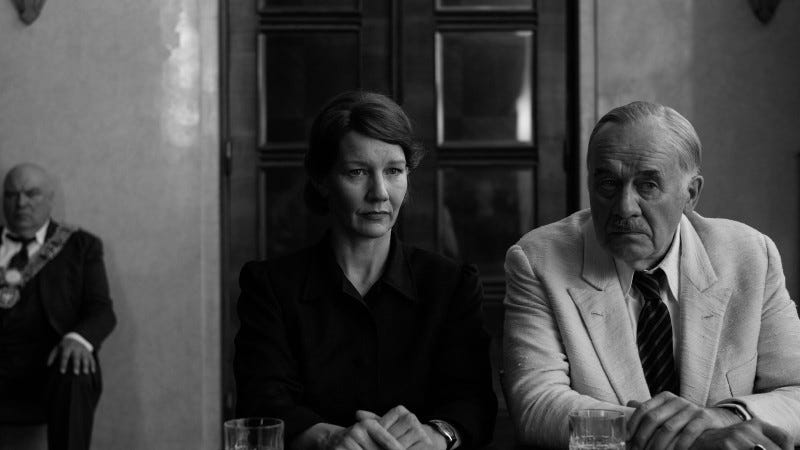
Pawlikowski’s narrative works on two layers: the father-child dynamic and that between nation and citizen. For better or worse, the relationship and conversations between Thomas and Erika can both be interpreted easily through personal and nationalistic lenses. Thomas justifies his journey by propagating Goethe’s belief in a “Good Germany” amidst what he perceives as moral decay in a “horrible” country with “horrible” people. Erika, conversely, sees Thomas as a mere “ornament”, whose prizes are easily co-opted by the politicians and elites to turn him into a symbolic figurehead without prompting any real national soul-searching. Thomas, like Germany, appears morally ambiguous: when faced with the death of a loved one, he decides not to suspend his journey to commemorate loss, but insists upon the road ahead.
The film works on a simple premise, while cinematographer Łukasz Żal’s continued collaboration with Pawlikowski retains their trademark wide shots, with tragic ramifications lurking beneath veneers of simplicity. Paired with its short runtime, the film asks a simple question: which version of a person, and a nation, one must choose? At a time defined by binary demands to choose a side (“Stalin or Mickey?” Socialism or consumerism?), the film’s choice to begin with Erika’s brother Klaus Mann (August Diehl), a man burdened by his lack of beliefs in a world demanding ideological conviction, is significant.
Perhaps too neatly, but nonetheless poignant, the film ends as it begins: Bach. Erika, another of Hüller’s exemplary performances, remarks that Klaus almost believes in God when listening to Bach. Where contemporary ideologies inspire indifference, art and culture aspire to spirituality and perhaps transcendence. As Thomas traverses Germany hoping his words can inspire a new way of thinking, the film’s conclusion almost suggests that the answer might have been there all along — not with his writing, but through and within the words themselves. The shot’s imagery is symbolic on both personal and political counts, with father and daughter sitting on the rubbles of a church, looking up at an organ being played.
Where Erika accuses Thomas of living in a “castle of words [he] can hide in,” and not the reality of a divided Germany that does not care for his awards or writing, these words are all that defend a purity of belief apparently stagnant in the Germany of then, and perhaps, of today too. After all, as the film acknowledges, the “idea” is corrupted in reality. Perhaps in the distance of the arts, the idea lives on.
Then again, the film also acknowledges that Goethe is closer to Marx than Hegel, when the former focuses more on empirical knowledge than the abstract. The film affirms this philosophy by the conclusion, recentering the journey from the political onto the personal. Where the abstractions of ideology provide no comfort, the realities and “erotics of the arts”, à la Sontag, are what we need: the spirituality of music and art, the dynamic of father and daughter, and the culture and humanity of a nation.
Fatherland will be screened on 1 and 14 October 2026 at Filmhouse as part of the German Film Festival.
Written by Daryl Cheong, edited by Phyllis Chan