

Photographs of a young Shim Eun-Kyung flashed across the screen, drawing affectionate laughter from the audience. The South Korean actress turned around, chuckling bashfully at the sight of her younger self. The moment opened the conversation between Shim and Singaporean filmmaker He Shuming, best known for Ajooma (2022).
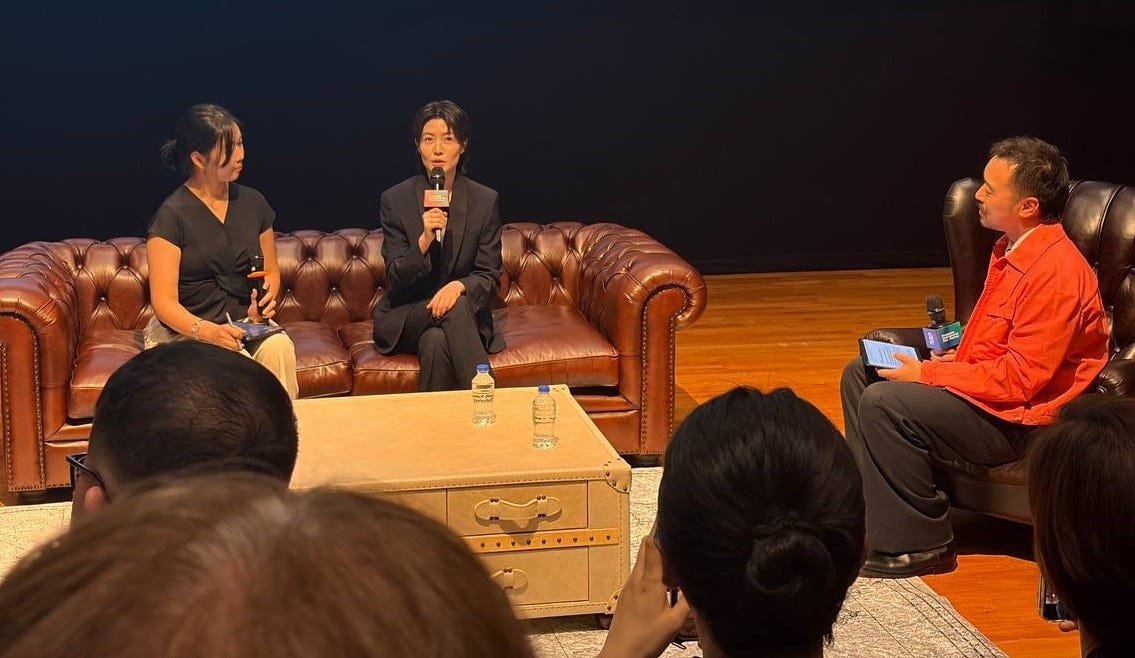
Having begun her career at the age of nine, Shim has since become one of South Korea’s most recognised actresses, with notable performances in box-office hits such as Sunny (2011) and Miss Granny (2014).
Reflecting on her early experiences as a child actress, Shim recalled relying largely on “instinct” and her first impressions of the script, while her mother, directors and fellow actors helped her understand the characters she portrayed.
However, as she grew older, Shim began to question this approach to acting. “I would act very passionately, but when I watched the end product it felt like something was missing,” she recalled. This prompted her to reconsider her methods, placing greater emphasis on analytical preparation and technical discipline.
“I try to pay attention to the details and I do my homework very diligently,” she explained. “Those thought processes keep on layering in my mind, and that actually brings out what I’m trying to express because it’s already in me.”
Shim also emphasised the importance of gaining experiences outside the film industry. Despite initially knowing little English, she attended school in Pittsburgh. She joked that studying English was “the first time that life was really tough,” but came to regard the challenges of adapting to an unfamiliar language and environment as valuable experiences for her personal and artistic growth.
Shim’s method of preparation was put to the test when she began working in Japanese cinema. For The Journalist (2019), she had to perform in Japanese despite not being fluent in the language. “I constantly listened to recordings of people speaking Japanese and recited the lines without emotion, like reading a textbook,” she recalled.
Working with Korean and Japanese versions of the screenplay, she used the former to understand the narrative and the latter to familiarise herself with the pronunciation and meaning of individual lines. Only then could she concentrate on conveying her character’s emotions.
Shim also discussed her collaboration with director Sho Miyake on Two Seasons, Two Strangers (2025), which screened at SGIFF last year. She recalled Miyake’s meticulous approach to directing, which involved rehearsing movements down to the number of footsteps taken and carefully choreographing gestures and glances within each frame.
Yet, Shim’s similar emphasis on detail and technique does not necessarily come at the expense of her instinct. Recalling her earlier performances in comedies, she stressed the importance of understanding “the situation and context that the character is in” to bring out their emotions.
In Sunny, Shim recalled noticing the camera movements during filming, prompting her to suggest a sequence in which her character clumsily greets a classmate before dropping her belongings and falling over. Her suggestion was subsequently incorporated into the film.
Looking back on a career shaped by both instinct and experience, Shim was asked what advice she would give her younger self. She concluded: “Experience it, be broken and come back again to experience all you can.”
Written by Phyllis Chan, edited by Daryl Cheong