


When Disney’s Raya and the Lost Dragon (2021) first released, there was much backlash to the monolithic depictions of Southeast Asia. In attempting to cater to an entire region by assimilating our many mythologies and cultures, Disney strays away from the inspiration. Conversely, in focusing on Filipino stories, Forgotten Island (2026) has perhaps created one of the most innovative animated Hollywood features of late.
Imagine the coming-of-age cringiness of Booksmart (2019) meets the party-induced amnesia of The Hangover (2009), married to the act of forgetting in Eternal Sunshine of the Spotless Mind (2004), all set to the fast-paced Gen Z rhythms of The Mitchells vs. the Machines (2019).
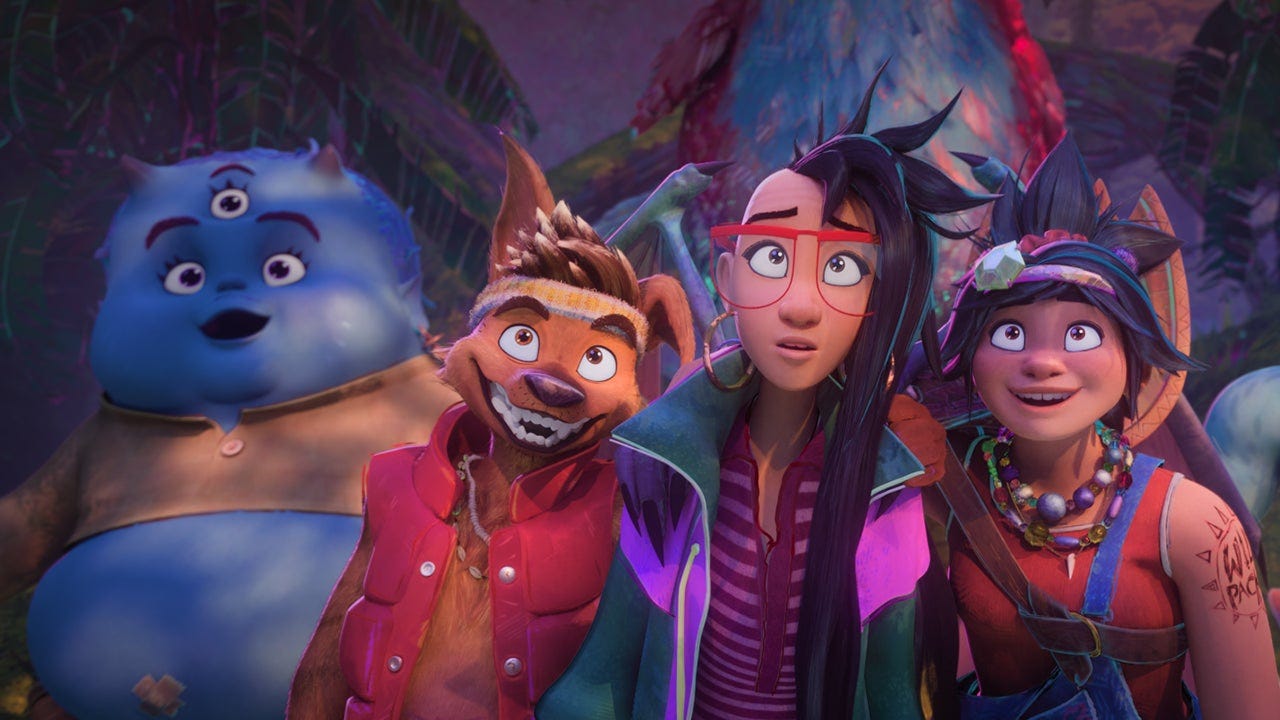
Long-time best friends Jo (H.E.R.) and Raissa (Liza Soberano) grew up together in the Philippines, bonding over their shared love of mythology at a time when few other children still believe in it. Now grown up, Raissa prepares to leave for Caltech in America. Upset, Jo finally finds the gateway into the forgotten mystical world of Nakali. There, they wake to find their memories wiped after a wild night, journeying together to recover their memory alongside a “Wild Pack” of impossible sidekicks: a charming but secretive were-dog Raww (Dave Franco), a tiyanak baby demon named Bungi (Manny Jacinto) and an insincere Mermahn. Together, they encounter a Batibat specialising in memory (Jenny Slate) and the dreaded vampire-like Manananggal (Lea Salonga).
This is probably what Marvel diehards felt watching Avengers: Infinity War (2018). The many tributes and easter eggs to Filipino mythology may feel overwhelming, but essentially rebuild a lived-in world. Yet for a Singaporean audience, much of this mythology also carries a sense of regional familiarity. Though different in name and form, many of the mythological creatures these characters draw from find close counterparts in the Malay-speaking world: the tiyanak baby demon recalls the toyol, while the manananggal shares certain characteristics with the pontianak. The quintessential characters and motivations remain familiar to us.
The film particularly stands out as an emotional story of love, loss and growth. In a sequence reminiscent of Up (2009), the death of one character is told simply in mere twenty seconds through the rich symbolism of the moon and puppet theatre. Much of the plot, after all, hinges on what the two girls are willing to sacrifice for each other: the friendship, their memories, and one’s future. As a work of entertainment, the story is emotionally evocative and never misses a beat.
A particular standout of the film is the empathetic treatment of its antagonists. Awe-inspiring and terrifying, their vengeances are also contextualised. Yet, maturely, the film never encourages you to forgive or overlook their shortcomings. Instead, it provides reason and allows the characters remedy, all while grounding their individual arcs in the narrative’s larger themes. Such considered writing paired with the impressive world-building is a testament to the excellence of the filmmakers.
Following its first weekend, the film has reported struggling box office sales. It is baffling considering that this is a thoughtful and well-constructed story rooted in universal ideas of friendship and loss. For the same audiences who hungered for the representation in Crazy Rich Asians (2018), Westworld or Hacks, this film offers meaningful representation that engages sincerely with the mythologies and cultures of a people.
Written by Daryl Cheong, edited by Phyllis Chan