

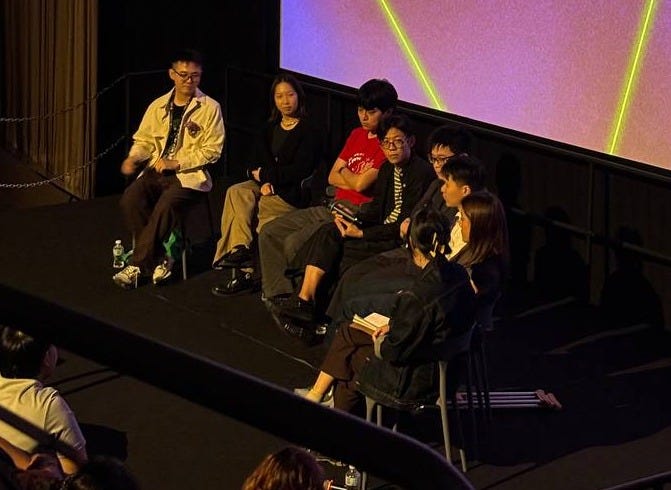
At the Singapore Panorama Programme 1: “There’s Gotta Be More” Q&A, the filmmakers candidly spoke about the various inspirations and creative processes behind their short films, and many shared surprisingly humble beginnings.
Cheryl Wong shared that the genesis of It’s Not Sweet came from an inane conversation with friends about family rituals while at a hotpot buffet. A stray comment about “only eating watermelons” before any buffet, coupled with an interest in exploring the emotionality of a young boy on the cusp of adolescence, became the unlikely starting point for her film.
Maximilian Liang then shared how art imitated life in Daphne as Woman (Crying), with the film’s narrative taking inspiration from brief encounters between Debra Teng, who plays the eponymous Daphne, and then-assistant director Nathanael Khoo, who also plays an assistant director in the film.
Both Seth Cheong and Enze Kay spoke on the impromptu and contained nature of their films, and their opportunistic approach to filmmaking. For Cheong, he spoke of a desire to follow up on his previous work Singaporeans on the Kamo River (2025) and felt that the chance to make Singaporeans at Gyeongbokgung Palace presented itself when he was on holiday in Seoul. Similarly, Kay seized the opportunity to make Adrift/A Rift while on holiday at a beach resort. “I just shot it on vacation. I had a rough idea of what the story was going to be,” he said.
Moderator and programmer Vess Chua prompted Cheong and Kay further, asking them to speak more about the budget constraints and the pros and cons of scaling down and making small productions with close friends. Kay took a moment to speak on finding inspiration through the work of his fellow filmmakers, giving credit to Cheong’s Singaporeans on the Kamo River as a model of filmmaking that he could follow. “Seeing all these high productions in films was a bit scary for me. [He] showed us a way of making films that didn’t rely on that, and I found it quite liberating.” The pair then spoke about the opportunities that presented themselves when the barriers to entry disappeared, encouraging those in the audience to pick up their phones and shoot their debut films. “Just whip out your iPhone and make it,” Kay suggested. “It’s a cliché that works in real life.”
Beyond that, Nah Yee Chern (director of Everything’s Peachy) and Wong expounded on the subject of expectations and disappointments in their respective films, exploring the throughline of seemingly desirable situations which may conceal deeper problems. Yee Chern revealed the shocking genesis of his film, shaped from interviews with someone who was in the process of being indoctrinated into a cult, and credited his film’s dark underbelly as merely a means of trying to fit the contours of a real experience. Wong, on the other hand, spoke on fixations and how truths typically remain below the surface of our interactions. “As adults, we project when someone cuts in line. We blow up at them, but it’s not really about them,” Wong remarked. “Maybe we had a really bad day.”
Chong Lii, on the other hand, discussed the creative choices behind Low-Hanging Fruit, responding to audience questions about whether certain visual and creative choices arose organically or were made strategically. “The annoying answer is it’s both,” Lii remarked. “You’ve got your coverage, but then you’ve got to take the space to really listen to the material.” When Chua drew parallels between the restless energy in Chong’s film and the dance sequence in Megan Lim En’s Coast to Coast, Lim explained how the film’s animated outburst reflected the frustrations of working life, particularly the emotions that young adults are expected to suppress. “Unfortunately, you can’t do that at work, so [what is] inside my head is what [the protagonist] is doing,” Lim jested.
It was difficult to give each filmmaker sufficient airtime to speak in detail about their work, given that they had only twenty-five minutes to share among the seven of them. Before too much more was said, the session concluded, with the moderator inviting audiences to continue their conversations with the filmmakers in the lobby instead.
Written by Adrian Ho, edited by Phyllis Chan