


On August 18, at a Q&A following a Filmhouse preview for the third part of Anthony Chen’s ‘Growing Up’ Trilogy, We Are All Strangers (2026), he remarked that audiences tend to “analyse the social and political commentary” of his films, but he “does not start a film with issues.” Yet, for a film so deeply concerned with class disparity and contemporary Singaporean socio-economic life, not beginning from “issues” does not remove the politics produced by its narrative choices.
There is no doubt that Chen is one of the most brilliant filmmakers to emerge from Singapore in recent years. His Cannes win opened doors, while his international work and producing efforts have charted new directions for Singapore cinema.
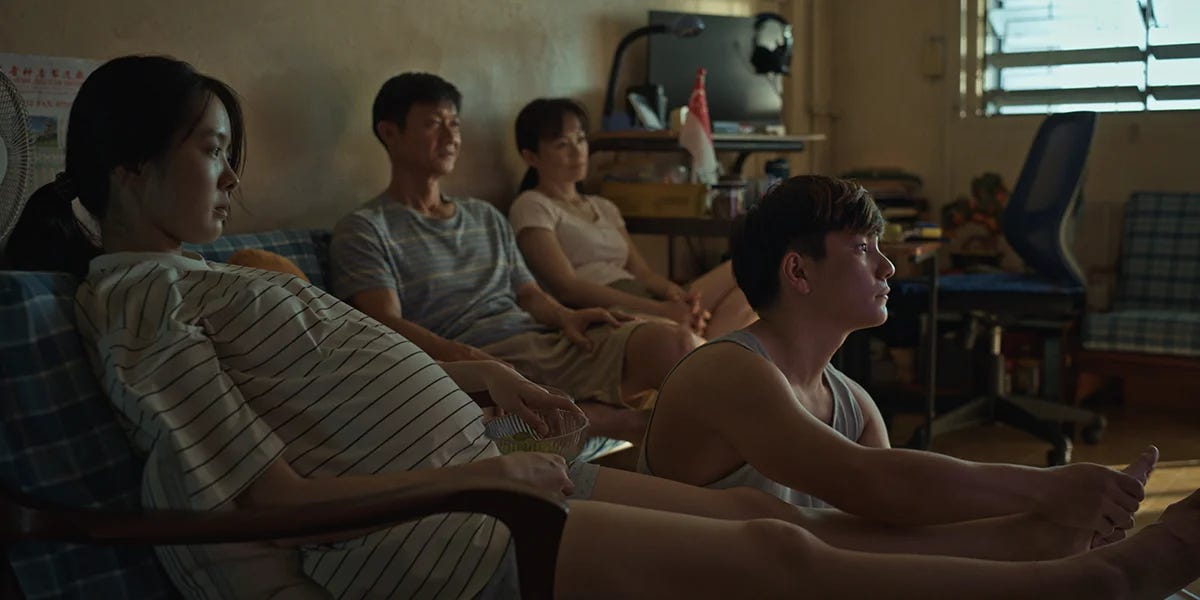
In We Are All Strangers, trilogy staple Yeo Yann Yann plays Bee Hwa, a kopitiam beer lady who marries Hokkien Mee vendor Boon Kiat (Andi Lim). His son, Junyang (Koh Jia Ler), marries Lydia (Regene Lim), an underage schoolgirl who becomes pregnant. What follows is a Kore-eda-esque story of a makeshift family forming around precarity.
The merits of the film are clear. Yeo is the standout: every pause, shift in expression and beat of comedic timing lends the film its emotional core. Chen also shows off his comic instincts with throwaway lines about K-Pop group BTS and Singapore that are sure to resonate with local audiences. Reminding us of the excellent filmmaker he is, Chen punctuates the smallest moments with formal wit: a date invitation becomes funny through the opening and closing of a lift door; a forbidden apple eaten on a bus holds love, sadness and pain at once.
Chen’s filmmaking capabilities are undeniable. Yet it is precisely because he is so capable of making compromise feel tender that the film’s ideology deserves greater scrutiny.
By the film’s conclusion, its protagonists have largely accommodated themselves to the structures around them. One returns to the meritocratic path as a means of escaping poverty; another takes up his father’s vocation as a hawker; another character who dares to imagine a different life ends up imprisoned. Through the warmth and beauty with which it resolves them, the film risks arguing for conformity as an end.
Chen seems to suggest that the system is imperfect, but dignity is found through adapting oneself to it rather than imagining life beyond it. That is not necessarily unrealistic. In fact, the truth is that his depiction is painfully realistic.
But, realism does not have to mean accepting the limits imposed upon one’s characters as the natural limits of adulthood.
Chen’s earlier films left more room for rupture. Ilo Ilo (2013) complicated depictions of the domestic worker by insisting upon Teresa’s emotional life and the influence she possesses beyond the labour expected of her. Wet Season (2018) allowed a woman to leave behind the roles and commitments that had come to define herself as she imagines freedom elsewhere. Whatever their flaws, these films found hope in characters whose desires exceeded the positions assigned to them.
We Are All Strangers, by contrast, increasingly locates dignity in learning how to inhabit those positions.
This tension becomes more apparent in the film’s treatment of Lydia. For almost a third of the film, she recedes from view, despite her class difference from the rest of the ensemble, opening up possibilities for a more complicated account of family and social mobility. Some of her dialogue also arrives without sufficient context: for instance, a throwaway line blaming her mother for her father’s departure feels disconnected from what the film has previously allowed us to understand about her.
Her mother Tracey, similarly, comes from a different class position that might have disrupted the relative harmony of the family Chen constructs. These omissions are therefore more than missed opportunities for character development. They point towards the contradictions the film chooses not to examine too closely in arriving at its vision of reconciliation.
Reflecting on his three-film journey, Chen said: “In your 20s, you are rebelling and complaining. In your 30s, you want to change the world. In your 40s, it’s not just [about] accepting things. The maturity comes from accepting that for all the criticism you might have, there is so much beauty and goodness you find around you––which in the past I wasn’t paying attention to.”
For many Singaporeans, Chen’s realist depictions of Singaporean lives will strike a meaningful chord. There is nothing inherently wrong with recognising beauty and goodness within circumstances one might once have criticised.
But there is a difference between discovering beauty within difficult conditions and rendering those conditions beautiful through cinema. This distinction matters because filmmaking is itself an act of curation: deciding whose perspective remains visible, which contradictions are allowed to persist, which compromises receive emotional closure, and deciding where a story ends.
In Chen’s “mature” version of Singapore, acceptance increasingly appears inseparable from dignity. His characters survive not by exceeding the frameworks around them, but by learning how to live within them. Perhaps, then, the question raised by the conclusion of Chen’s trilogy is not whether we eventually learn to appreciate Singapore despite its imperfections, but why maturity must come at the expense of imagining new possibilities.
We Are All Strangers (我们不是陌生人) releases in Singapore cinemas on August 20, 2026.
Written by Daryl Cheong, edited by Phyllis Chan.

