

What makes the documentary genre so intriguing to me is the question of who controls the narrative. A genre many associate with the promise of objectivity is perhaps the most subjective of all. Does the documentarian really have full control over the narrative? Do their subjects have agency? Are we, as audiences, projecting our own assumptions onto the images before us?
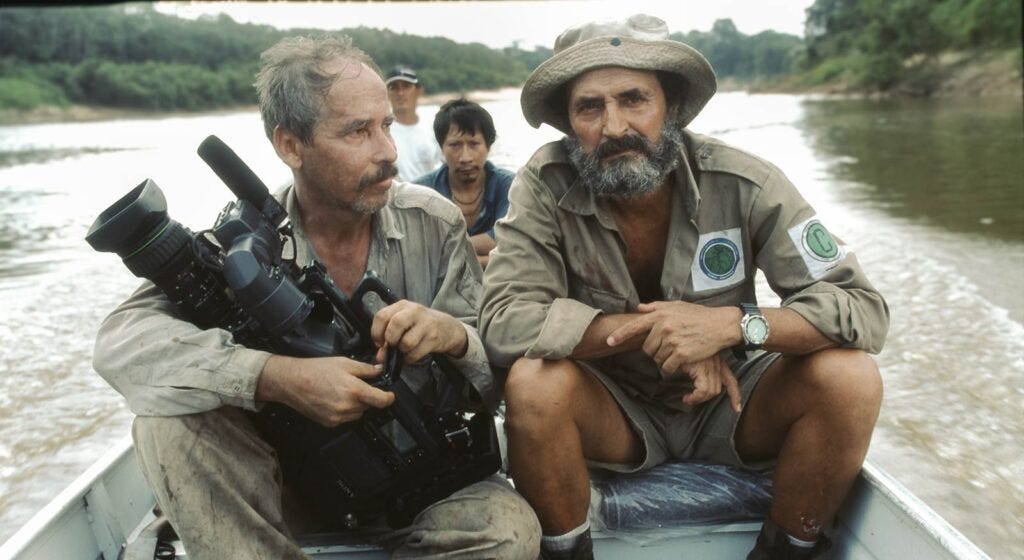
Nathan Grossman’s Amazomania complicates these questions by turning the documentarian into the documented. Using journalist Erling Söderström’s archival footage from a 1996 expedition into the Brazilian Amazon, the film follows his return in 2023, where he is confronted by the very people he once filmed. Grossman makes a point of leaving in Söderström’s unguarded moments from his 1996 footage: walking into frame, putting on his shoes, and even looking visibly frustrated when someone speaks behind the camera, prompting him to say, “Please don’t talk.” The journalist, once in control of the narrative, now finds himself at the mercy of another filmmaker’s editorial choices.
With the goal of establishing contact with the Korubo people amid escalating violence between the community and local settlers, the 1996 expedition, led by Brazilian official Sydney Possuelo, makes for an uncomfortable viewing. Equipped with hiking gear, cameras and even cigarettes, the team ventures into the forest like explorers discovering an uncharted world. Along the way, they kill animals for food, but never forget to pose for photographs with a dead armadillo or capture an image of a skinned monkey. As they approach closer to the Korubo, the camera-wielding team comes across an indigenous burial structure, proceeding to move it around, and gawk at the remains of a child—all while casually smoking a cigarette.
Possuelo repeatedly describes the Korubo as “frightened” and “scared,” leaving food and cooking pots to appease them. It becomes harder to ignore such paternalistic language when the team were quick to dress the Korubo in Western clothing when contact is finally established. One expedition member even urged another to pose for a photograph with the Korubo, gleefully saying, “Stand next to him. Don’t miss the opportunity.”
Söderström does not attempt to conceal his own exoticising gaze. In his 2003 documentary, The Hidden Tribes of the Amazon, he describes the Amazon as a mystical realm populated by “night spirits” and “imaginary beings”, describing the indigenous people as living in a world separate from “our world.”
Unlike Söderström, Grossman attempts to give us the perspectives of Korubo community members, including Tsamavo, Xikxu and Takvan, who were part of the initial contact. What initially appeared to be an encounter between the ‘frightened’ Indigenous people and their ‘benevolent’ visitors is overturned by the Korubo’s own recollections. Tsamavo recounts how Xikxu exclaimed, “Now it’s ok! They are cowards, come out from your hidings, don’t be afraid.”
During the post-screening Q&A, Grossman revealed that the documentary began with his discovery of Söderström’s archival tapes. Comparing the raw footage with the journalist’s finished productions, he noticed a “discrepancy between what [he had] seen in the raw material and how it was portrayed in the media”. This became the starting point for a documentary that interrogates not only Söderström’s representation of the Korubo, but also the very act of documenting another community.
The film’s most revealing moments arrive when Söderström returns to the community, only to find himself confronted with questions about his earlier visits and the ownership of his footage. Community representative Takvan Vakwë questions Söderström’s intentions: “Why did you come here so often? To our community. What were you thinking at that time? Why did you bring such a big camera? Why did you film our culture so much?” Söderström, meanwhile, appears reluctant to compensate the community, insisting that he made little money from his work.
There is something particularly galling about his defensiveness. Back in Sweden, Söderström proudly displays an Indigenous blowpipe and photographs from his travels, transforming everyday objects and encounters into souvenirs. He also maintains a website devoted to the Korubo, its contents protected by international copyright law. The irony is hard to miss: the journalist asserts ownership over images of a community whose members had little say in their production or circulation.
“I deeply hate when someone tries to pressure me to make decisions when I’m not ready for it,” Söderström protests. But did the Korubo ever have the opportunity to refuse his camera?
Grossman acknowledged the ethical complexities of his own production during the Q&A. “Complete fairness can never exist,” he remarked, explaining that his priority was establishing whether the Korubo community wished to participate in the documentary at all. The community, he explained, wanted “the name of the Korubo to reach the world further”, while the production committed to allocating half its proceeds to them.
Perhaps Amazomania‘s greatest achievement lies in making us reconsider our own gaze. By returning to the same images through different perspectives, the film demonstrates how documentaries can simultaneously reveal and obscure reality. As Grossman remarked, cinema can help us understand “what is a gaze” and reconsider our responses to images after learning something new. The question is no longer simply who holds the camera, but who gets to determine what its images mean.
Written by Phyllis Chan, edited by Daryl Cheong