

It was a night of celebration and nostalgia at the Marina Bay Sands Grand Ballroom as Aamir Khan candidly reminisced about a career in cinema that has spanned forty years. Moderated by Singapore-based stand-up comic Rishi Bundhrani, the night started with brevity as Bundhrani exercised his crowd-working skills, getting the audience raring for Khan’s entrance.
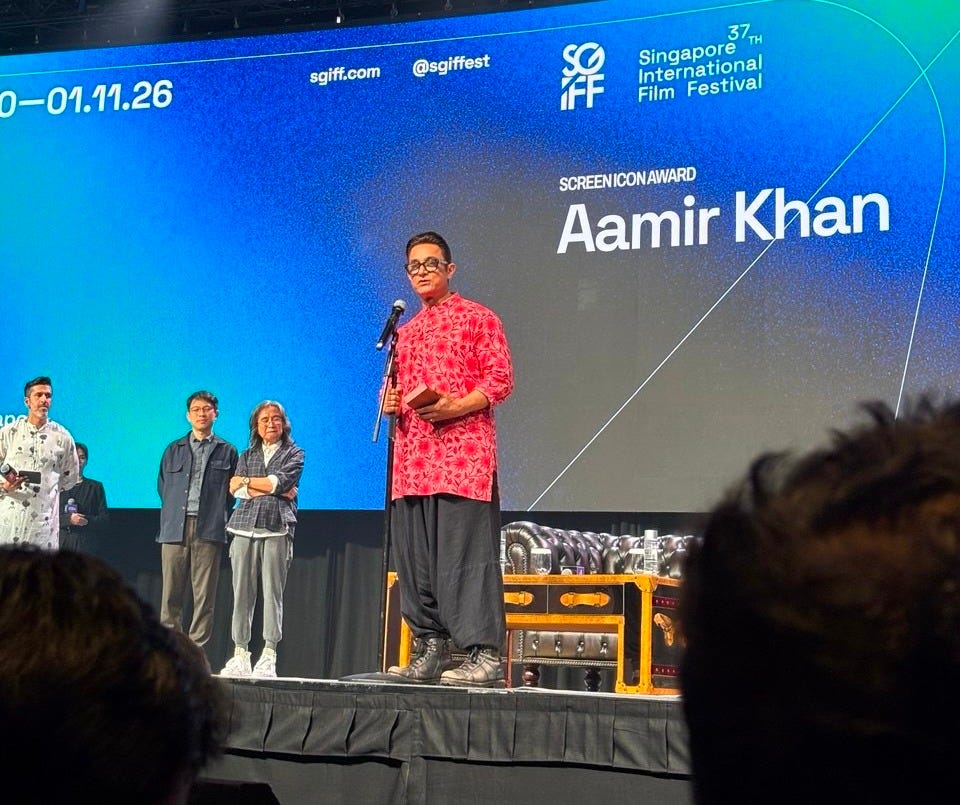
When Khan finally took the stage to accept his Screen Icon Award and offer his acceptance speech, there was a palpable shift in the room. Khan reintroduced a sincere air to the occasion, expressing gratitude to his collaborators and acknowledging the importance of timing and fortune in his stellar career.
Khan spoke on the centrality of cinema to his life, describing himself as a highly engaged and emotional film viewer. He claims he converses with characters on-screen and his cinematic experiences often end in tears — not from any heartstrings being tugged, but from the lack of blinking being drawn into the film.
Khan also reminisced about his childhood and credited the time he spent with his producer-director father, listening to filmmakers pitching stories, as the impetus for his eventual career in film.
A true champion of the cinematic arts, Khan took the opportunity to give advice to aspiring filmmakers, encouraging them to pursue their dreams, while stressing the financial responsibility that comes with artistic freedom.
The discussion then turned to the legacy of his works, including Lagaan and its 25th anniversary, with which Khan hoped that audiences would still connect to the film the way they did during its initial release. Khan also revealed that director Raju Hirani is working on a script for a possible Three Idiots sequel, to which the crowd responded with uproar.
Khan later confessed that he was “worried for the youth” and spoke about social media and the impossible task of stepping away from our devices. He not only proclaimed that “you must have time to waste,” but also that it was “essential for imagination.”
Khan also spoke on piracy and credited it with his rise in popularity in the East. This was met with nervous laughter from both the audience and the moderator, who seemed committed to remaining in the good books of the festival.
Beyond that, Khan also spoke frankly on the future of artificial intelligence and its effects on the industry, and while recognising the job opportunities taken away from skilled labourers, he also encouraged the audience to “embrace A.I. as a tool” rather than hope for it to pass, as he believes that “it will not go away”. However, he goes on to counter that nothing would replace a “mother’s touch” and that A.I. will still require human supervision.
Khan then continues the conversation by giving flowers to his collaborators, and speaks to the communal aspect of filmmaking, both in the creative process and in the bonds forged through the productions. When prompted on the lowest moments in his career, Khan broke down into tears while sharing how the COVID-19 lockdown prompted him to recognise the personal cost of decades of workaholism, as he came to terms with the precious years he missed with his children and loved ones. On a night celebrating his cinematic achievements, Khan pleaded for the audience to take stock of their lives, to recognise “the people who are really important to us” and to “nourish those relationships” instead.
Written by Adrian Ho, edited by Phyllis Chan