

Lagaan: Once Upon a Time in India (2001) was the first film produced by Aamir Khan Productions after its establishment. With a budget of approximately 250 million rupees (US$2.6 million), it was one of the most expensive Indian films made for its time. Inspired by B. R. Chopra’s sports film Naya Daur (1957), the film is set in 1893, when India was still under British colonial rule.
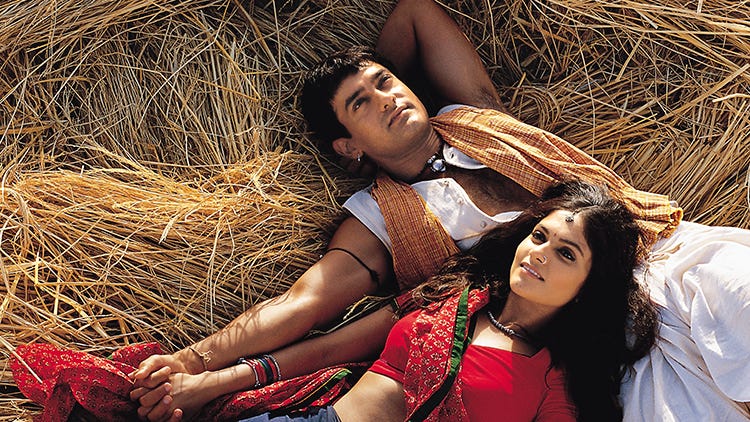
The story takes place in Champaner, a small village that had been suffering from a prolonged drought, leaving its villagers with no harvest. To make matters worse, the local colonial ruler, Captain Andrew Russell (Paul Blackthorne), demands a 30% increase in land tax. Already struggling to make ends meet, the villagers are further enraged by this oppressive decree. Bhuvan (Aamir Khan), a young farmer in the village, steps forward to lead the villagers in voicing their discontent against the British colonisers. In response, Captain Andrew proposes an almost impossible challenge: if the villagers can defeat the British in a cricket match three months later, they will be exempted from paying land tax for the next three years. With the prospect of escaping their crushing tax burden at stake, the villagers unite and begin preparing for the match.
The film’s audiovisual language is, without a doubt, impressive. As a film aimed at a mass audience, director Ashutosh Gowariker clearly understands how to engage viewers emotionally and build dramatic tension. The screenplay is tightly constructed, with almost every aspect carefully accounted for. The film also demonstrates a strong anti-colonial consciousness, while bringing together a diverse range of genres and elements, including sports, musical sequences, historical drama, romance and political critique. It is, in a sense, a cinematic melting pot, yet one in which all the ingredients come together remarkably well. The three-day cricket match in the latter half of the film is particularly gripping, with tension mounting at every turn. The character development and minute details of the game are handled with considerable precision and dramatic force, making the match thoroughly engrossing.
Nevertheless, there are aspects of the film that invite further scrutiny. As a commercial blockbuster infused with an anti-colonial critique, Lagaan occasionally allows its narrative conventions to take precedence over its political concerns. While the film exposes the violence and injustice of colonial rule, it also, to some extent, positions the colonisers as representatives of a supposedly civilised order. Cricket becomes not only a means for the villagers to secure tax relief, but also a way for them to demonstrate their abilities and worth by mastering a sport introduced by the colonisers.
Perhaps this is a compromise made in the service of commercial storytelling, establishing dramatic conflict and delivering an ultimately satisfying victory. Yet it raises an important question: when the colonised must play by the rules established by the coloniser to secure their rights, does their victory represent a genuine challenge to the colonial order, or does it merely demonstrate that they, too, are capable of participating in it? This may be the central contradiction of Lagaan: while the film responds to colonial oppression with a rousing narrative of collective resistance, it does not entirely escape the framework of values constructed by colonialism itself.
During the post-screening Q&A, Aamir Khan reiterated the importance of commercial considerations in filmmaking. In response to an audience member who asked what advice he would give to young filmmakers, he said: “Filmmaking is an art form, but it also involves economic considerations. If you want freedom, you need to be responsible for the commercial aspect. With freedom comes a great deal of responsibility. We need to be responsible to everyone, because everyone has a stake in it.”
This philosophy is reflected in the commercial performance of Lagaan, which grossed approximately ₹65.97 crore (US$5.3 million) in 2001, establishing itself as a commercial success. The film demonstrates how artistic ambition and a clear political stance can coexist with commercial viability.
“Don’t give up your dream, but you can compromise for the greater good, unless it touches the bottom line of your dream,” he continued.
The Q&A was well attended by enthusiastic fans, with hands constantly shooting up as audience members eagerly waited for their turn to ask questions. The excitement was palpable. Many had clearly been anticipating Aamir Khan’s appearance at the theatre, and after the screening, audiences flocked around him for photographs. The enduring charisma of a film star remains undeniable, even here in Singapore, where the audience’s enthusiasm was every bit as intense as the tropical heat.
P.S. The filmmaker has confirmed a sequel to Delhi Belly (2011), the dark comedy produced by Aamir Khan. To all the fans out there: hang in there!
Written by Lee Peng Ming, edited by Phyllis Chan